
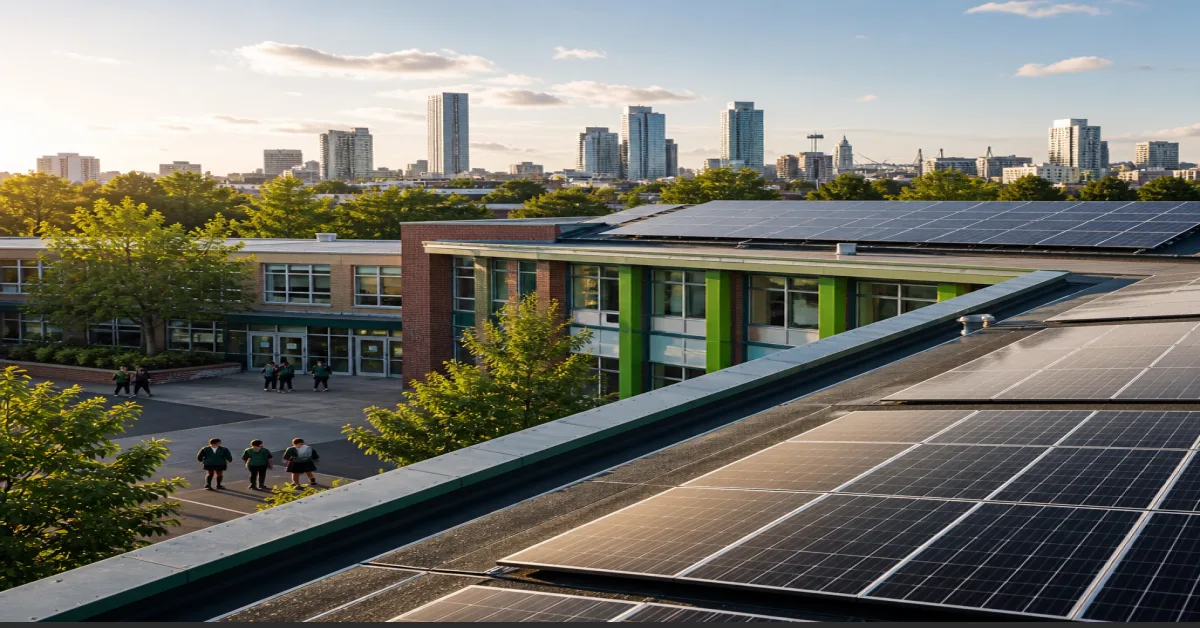
School Solar Panels Manchester | Bee Solar
Daytime term-time loads fit solar exactly. 120 kWp typical, installed in holidays.
120 kWp
Typical school system size
30-50%
Operational cost reduction
3-5 days
Holiday-window installation
8am-3pm
Load matches generation
What's Covered on This Page
- School-Hours Generation vs Bills: Why Manchester Estates Fit Solar
- Sizing a School PV System to Daytime Load, Not Maximum Roof
- DNO Applications, Planning Rights, and Asbestos on Older Manchester Schools
- Funding, Procurement, and Own-Asset vs PPA
- Holiday-Window Installation, Exams, and Safeguarding
- Survey, Quote, and Next Step for Greater Manchester Schools
- Frequently Asked Questions
Need Solar for Schools?
0161 570 0596Get A Free Quote. Bee Commercial Solar is ready to help.
School-Hours Generation vs Bills: Why Manchester Estates Fit Solar
School electricity demand in Greater Manchester typically peaks between 8am and 3pm, which overlaps solar generation windows, so most generated kWh displace expensive on-site use rather than being exported. This load-match is the core financial mechanism that makes school solar commercially viable, not an environmental gesture. A typical secondary school in Manchester can spend upwards of £40,000 per year on electricity, money that competes directly with teaching staff and classroom resources. This pattern of rising bills and daytime demand is part of why UK institutions are moving to solar in increasing numbers.
This page is for Greater Manchester schools on the Electricity North West network, not US Manchester, Connecticut, where much of the SERP noise originates. Bee Solar and Bee Commercial Solar deliver school-estate installations locally, from Didsbury to Moston, where large unshaded roofs make delivery realistic.
The decision drivers for a Manchester school estate are straightforward:
Load Match
Daytime kitchens, IT suites, labs, and classrooms consume power exactly when panels generate it.
Bill Pressure
Energy spend competes with teaching budgets; solar reduces operational costs by 30 to 50 percent.
DfE Trajectory
Schools must work toward net-zero carbon emissions; solar is a practical first step.
Permitted Development
Most rooftop arrays proceed without full planning permission.
Any carbon or net-zero benefit must be paired with £/kWh mechanics. Solar is not free and not zero-cost without a named funding mechanism. The first survey step is half-hourly load analysis through our energy consulting service, which maps consumption against generation before any design commitment. This load analysis is what separates a financially sound system from one that merely looks good on a roof.
Sizing a School PV System to Daytime Load, Not Maximum Roof
Design starts from at least 12 months of half-hourly supplier data, then a roof survey covering orientation, pitch, structure, and shading, then Manchester irradiance modelled against actual usage. Typical school systems fall in the 30 kWp to 100 kWp band, requiring roughly 200 to 600 m² of usable roof. Flat-roofed secondary schools around Gorton and Moston often use ballasted angled mounting frames across multiple blocks, avoiding any roof penetration that could compromise waterproofing. This entire sequence follows our solar design process, which applies the same rigour to every commercial rooftop.
The design sequence follows a fixed order:
Half-Hourly Data
Retrieve 12 months of half-hourly consumption data from the energy supplier.
Roof Survey
Survey roof area: orientation, pitch angle, structural load capacity, and shading.
Load Mapping
Map usable roof space against energy demand to calculate system size in kWp.
Generation Modelling
Model generation using local irradiance data, matched against actual usage patterns.
DNO & Planning
Confirm DNO connection requirements and check permitted development or planning status.
Full Proposal
Produce a full proposal with projected savings, payback period, and carbon reduction figures.
- Retrieve 12 months of half-hourly consumption data from the energy supplier.
- Survey roof area: orientation, pitch angle, structural load capacity, and shading.
- Map usable roof space against energy demand to calculate system size in kWp.
- Model generation using local irradiance data, matched against actual usage patterns.
- Confirm DNO connection requirements and check permitted development or planning status.
- Produce a full proposal with projected savings, payback period, and carbon reduction figures.
A primary school in Didsbury has different demand than a secondary academy with science labs, server rooms, and a sports hall. The sizing logic follows the load profile, not the roof area. A primary school's demand may peak earlier and drop off as pupils leave, while a secondary with evening sports fixtures or IT server loads may carry demand later into the afternoon. Export under the Smart Export Guarantee pays less than on-site use, so designing to roof maximum destroys the economics. There is no universal 33 percent rule in our design method; sizing is driven by measured daytime load, not viral rules of thumb.
Future-proofing matters. If the school is considering EV chargers for staff parking or using solar battery storage for holiday surplus, those loads are integrated into the initial electrical design to avoid costly rework later. A battery can capture summer holiday surplus for use when staff return, but it is an optional addition, not a mandatory component. If the roof needs replacement within roughly five years, repair or bundle roof works first. Installing panels on a roof nearing replacement means double expenditure and disruption to the same area twice.
Do not oversize. Generation should align with daytime consumption. Excess power exported to the grid earns far less than power used on site. Maximise self-consumption, not panel count. The Smart Export Guarantee is a useful safety valve for occasional surplus, not the financial foundation of a school system.
DNO Applications, Planning Rights, and Asbestos on Older Manchester Schools
Three compliance realities determine whether a Manchester school project proceeds in the chosen holiday window: Electricity North West connection approval, permitted development versus planning permission, and refurbishment and demolition asbestos surveys. These are the friction points that delay projects when handled late. Each one has a clear sequence, and none of them should surprise a school that has done its homework.
DNO Applications and Grid Connection
Every grid-connected school PV system requires approval from Electricity North West. Rules set out in the UK grid compliance regulations govern all commercial connections.
Permitted Development vs Planning
Most rooftop school arrays fall under permitted development rights. Exceptions include listed buildings and conservation areas.
Asbestos Surveys
Many pre-2000 Manchester schools contain ACMs. A refurbishment and demolition survey is legally required before intrusive works.
Critical Path Sequencing
Asbestos and planning checks on survey day, G99 submitted before holiday dates are locked.
DNO Applications and Grid Connection
Every grid-connected school PV system requires approval from the District Network Operator, which for Manchester is typically Electricity North West. The application pathway depends on system size, and the rules are set out in the UK grid compliance regulations that govern all commercial connections:
- G98: Systems under 16A per phase use a simple notification, usually confirmed within days.
- G99: Systems between 16A and 50 kW require a technical study, typically taking six to eight weeks.
- Larger arrays: May require grid reinforcement, adding time and cost that must be flagged early.
Submit the DNO application as soon as the design is frozen, often months before the holiday install. Late G99 submission is the primary cause of project overruns, and once the technical study begins, it cannot be accelerated by the installer or the school. Bee Commercial Solar handles DNO paperwork within the commercial installation pathway, including the technical study coordination and any reinforcement discussions with Electricity North West.
Permitted Development vs Planning Permission
Most rooftop school arrays fall under permitted development rights, so no full planning application is required. Exceptions include listed buildings, conservation areas such as parts of Didsbury, and ground-mounted arrays exceeding size and height limits. These are checked on day one. Even when permitted development applies, we notify the local planning authority as good practice, which safeguards the school against future inquiries. A school in a conservation area is not automatically blocked, but the process takes longer and may require a planning application with heritage impact assessment.
Asbestos Surveys on Older School Stock
Many Manchester schools built before 2000 contain asbestos-containing materials within roof build-ups. A refurbishment and demolition asbestos survey is legally required before intrusive roof works if one is not already documented. Request the school's asbestos management plan at the outset. Asbestos presence does not automatically prevent PV installation, but it changes the mounting sequence and may require remediation first. Older building fabric around Gorton and Levenshulme often requires this modified approach, where mounting brackets are positioned to avoid disturbing ACMs or where encapsulated materials are scheduled for removal first.
Sequence these three items as a critical path: asbestos status and permitted development or listed checks happen on survey day, while the G99 application is submitted before holiday dates are locked. This ordering means the survey informs the DNO submission, and the DNO timeline runs in parallel with any planning or asbestos remediation work.
Funding, Procurement, and Own-Asset vs PPA
Cost depends on kWp, roof condition, DNO, asbestos method, and funding route — there is no single Manchester price.
- Salix Finance: Interest-free loans to state-funded schools through the DfE, repaid from energy savings. The loan can also cover enabling works such as asbestos remediation or roof repairs where they are required for the solar installation.
- Devolved Formula Capital (DFC): Smaller capital grants; some schools pool two years to part-fund a system.
- Power Purchase Agreements (PPAs): A third party owns the system; the school buys electricity at a lower fixed rate with no upfront capex. This model is demonstrated in a practical PPA case study from a recent zero-capex project.
- CIF / ESFA: Condition Improvement Funding for academies and sixth-form colleges, often stronger when bundled with roof repairs.
Procurement rules differ by school type. Local authority maintained Manchester schools typically follow council frameworks. Academies and multi-academy trusts have more flexibility but must demonstrate value for money, and most projects above threshold require three competitive quotes. Bee can supply governor-ready packs with the necessary documentation, including the cost-benefit analysis, payback projections, and compliance summaries needed for board approval.
| Decision | Owned System (Salix / DFC / CIF) | Power Purchase Agreement |
|---|---|---|
| Upfront cost | Loan or grant funded; repaid from savings | Zero capital expenditure |
| System ownership | School owns the asset | Third party owns and maintains |
| Electricity cost | Captures full savings after payback | Fixed lower rate per kWh |
| O&M responsibility | School or installer contract | Owner responsible |
| Best for | Schools with capital access and long-term control | Schools with no capital budget or procurement flexibility |
The Carbon Trust reports that schools combining funding routes frequently achieve near-zero out-of-pocket costs. This is an attributed observation on strategic programme stacking, not a Bee guarantee. PPA removes capex and ownership but you buy the power; owned systems capture full savings after payback. Choose on cash position, control, and procurement rules, not on "free panels" claims. A PPA contract typically runs 20 to 25 years, so the school should review the escalation clause and exit terms before signing.
Greater Manchester Combined Authority and Green City collective schemes exist as context, but Bee does not run those programmes. A direct path still requires survey, DNO, asbestos checks, and term planning. Run the survey in parallel while waiting for any collective expression-of-interest window so a holiday installation slot is not missed. Collective schemes may offer procurement convenience, but the site-specific compliance work applies regardless of how the installer is procured.
Holiday-Window Installation, Exams, and Safeguarding
Schools do not need to close or send pupils home during installation. Work is roof-only, with work zones kept separate from pupil areas, and installers carry enhanced DBS checks and follow school visitor and contractor policies. Most Greater Manchester school projects run during the six-week summer window, half-term, or Easter, with scaffolding erected on day one of the break and commissioning completed before September.
No noisy roof work is scheduled during GCSE, A-level, or primary SATs windows. Project managers cross-reference the school's exam timetable before finalising dates, and this conversation happens at the survey stage, not when the scaffold arrives. The typical programme follows a numbered sequence:
Survey & Design
Term-time site survey and system design with minimal disruption.
Approvals
DNO application and planning confirmation submitted well ahead of the holiday window.
Scaffolding
Scaffolding erected on the first day of the break.
Installation
Panel mounting, inverter installation, and electrical work completed mid-break.
Commissioning
Full commissioning, testing, and handover before staff return.
- Term-time site survey and system design with minimal disruption.
- DNO application and planning confirmation submitted well ahead of the holiday window.
- Scaffolding erected on the first day of the break.
- Panel mounting, inverter installation, and electrical work completed mid-break.
- Full commissioning, testing, and handover before staff return.
Large secondaries with multiple roof sections can split installation across consecutive half-terms, so each phase is completed and commissioned before the next break begins. The academic calendar is a project-management input, not an afterthought. The long pole remains the DNO connection approval, submitted months before physical installation so the holiday window is labour, not waiting. If asbestos remediation is required, that work is scheduled in the same holiday window ahead of the panel mounting. Once the system is live, schools can track performance through how solar performance is monitored to confirm the asset is delivering forecasted savings.
Survey, Quote, and Next Step for Greater Manchester Schools
Bee Commercial Solar provides the full local pathway: site survey, half-hourly load modelling, DNO and planning and asbestos screening, holiday-window programme, and a governor-ready proposal. The quote is not a price from roof area alone; it is constrained by load profile, DNO requirements, building fabric, and the academic calendar. Each proposal includes the projected annual savings, payback period, and the funding route most appropriate for the school's status. Our track record on school estates is demonstrated in a recent primary school installation that delivered near-identical benefits.
Site survey with half-hourly load modelling
DNO, planning and asbestos screening
Holiday-window programme around exams
Governor-ready proposal with savings and payback
Surveys cause low disruption during term time, and the proposal follows once the data is analysed. Contact Bee Solar on 0161 570 0596 or use the Get a Free Quote form to book a site survey. Related services include commercial solar installation, half-hourly load analysis, battery storage for holiday surplus, and financing and PPA guidance. Our experience also extends to similar commercial installations, such as retail, which share the same high daytime load profile.
Frequently Asked Questions
Frequently Asked Questions
Can Manchester schools install solar panels without planning permission?
Most Manchester schools can install solar panels under permitted development rights, so full planning permission is not needed. This applies to the majority of flat-roofed school buildings across the city. There are size and height limits to stay within. Listed buildings or schools in conservation areas like parts of Didsbury may need consent, and ground-mounted arrays over certain sizes require a full application. We check this during the initial survey so you know exactly where you stand before work begins.
How long does a school solar installation take from start to finish?
A typical school solar installation in Manchester takes four to eight weeks from survey to switch-on. The physical roof installation usually takes three to five days, scheduled during school holidays wherever possible. Larger sites with multiple roof sections may need two holiday periods to complete safely. The DNO application process can add six to eight weeks for systems requiring G99 approval, so early submission is critical.
What happens to the solar energy a school generates but does not use?
Any surplus electricity is exported back to the grid under the Smart Export Guarantee, and the school earns a payment for every unit sent back. However, exported energy earns far less than energy used on site. This is why systems are designed to match daytime consumption as closely as possible, maximising power used directly in classrooms, kitchens, and IT suites.
Do Manchester schools need to close or send pupils home during installation?
No, your school does not need to close during a solar installation. Work happens on the roof, away from pupils. Installers carry enhanced DBS checks and follow your school's visitor and contractor policies. Site access is planned carefully to keep all work zones completely separate from pupil areas throughout the project.
What funding options are available to state schools in Manchester right now?
State-funded schools in Manchester can access Salix Finance interest-free loans, repaid directly from energy savings. Devolved Formula Capital grants are another option, and some schools combine two years of DFC to part-fund a system. Power Purchase Agreements let a third party own the panels at no upfront cost to you. Academies can also apply through CIF funding, sometimes bundling solar with roof repair projects.
How much roof space does a Manchester school typically need for solar panels?
Most Manchester schools need between 200 and 600 square metres of usable roof space for a worthwhile solar system. Flat roofs are ideal because angled mounting frames can be used to get the best tilt. Orientation, shading from nearby buildings, and structural load are surveyed before confirming the layout. Even a modest primary school roof can generate enough power to cover classroom electricity during school hours.
How much would it cost to put solar panels on a school in Manchester?
Cost depends on system size in kWp, roof condition, DNO or reinforcement requirements, asbestos survey findings, and the chosen funding route. A typical school system in the 30 kWp to 100 kWp band will vary significantly based on these factors. An illustrative 120 kWp system at an out-of-area primary school delivered annual savings of approximately £28,000 with a 5.4-year payback, but this is not a Manchester average or a Bee guarantee. A site survey with half-hourly load analysis produces the actual figures for your estate.
Are solar panels worth it for schools?
Solar panels are worth it for schools when daytime load aligns with generation, which it does for most Manchester schools operating between 8am and 3pm. The financial case is driven by self-consumption of daytime kitchen, IT, classroom, and lab load, not by maximising roof coverage or export income. With Salix interest-free loans or PPA structures, the savings typically exceed the cost from the first year.
What is the 33% rule for solar panels?
There is no universal 33 percent rule in our design method. System sizing is driven by measured daytime load from 12 months of half-hourly data, not by a viral rule of thumb. Some residential guidance suggests sizing to a percentage of annual consumption, but school estates need load-matched design to avoid oversizing that destroys the economics.
Why are people getting rid of their solar panels?
Residential solar owners sometimes remove panels for roof repairs or replacement, underperformance issues, or because poor export rates made the original system uneconomic. School systems are different. They are designed around daytime consumption and funded through routes like Salix or PPA that tie repayments to savings, so the abandonment pattern seen in some residential cases does not apply to properly designed school installations.
Should we wait for a Greater Manchester collective solar scheme?
You can run a site survey in parallel while waiting for any collective expression-of-interest window. Collective schemes may offer procurement convenience, but they still require a survey, DNO approval, asbestos checks, and term planning. Acting in parallel means a holiday installation slot is not missed while waiting for scheme timelines to firm up.
Do we need a G99 application for school solar on Electricity North West?
Systems between 16A and 50 kW on the Electricity North West network need a G99 application with a technical study, typically taking six to eight weeks. Systems under 16A per phase use a simpler G98 notification, usually confirmed within days. Larger arrays may require grid reinforcement. The DNO application is submitted as soon as the design is frozen, often months before the holiday install window.
Ready to Explore Solar for Your School?
We will survey your estate, model savings against term-time load, and present a governor-ready proposal — no obligation, no disruption to exams.
Holiday-window installs. Term-time surveys with enhanced DBS installers.