
A credible net zero strategy for business is a governed, sequenced plan — not offsets first. Rooftop solar is the starting capital pillar that cuts Scope 2, funds electrification and evidences progress.
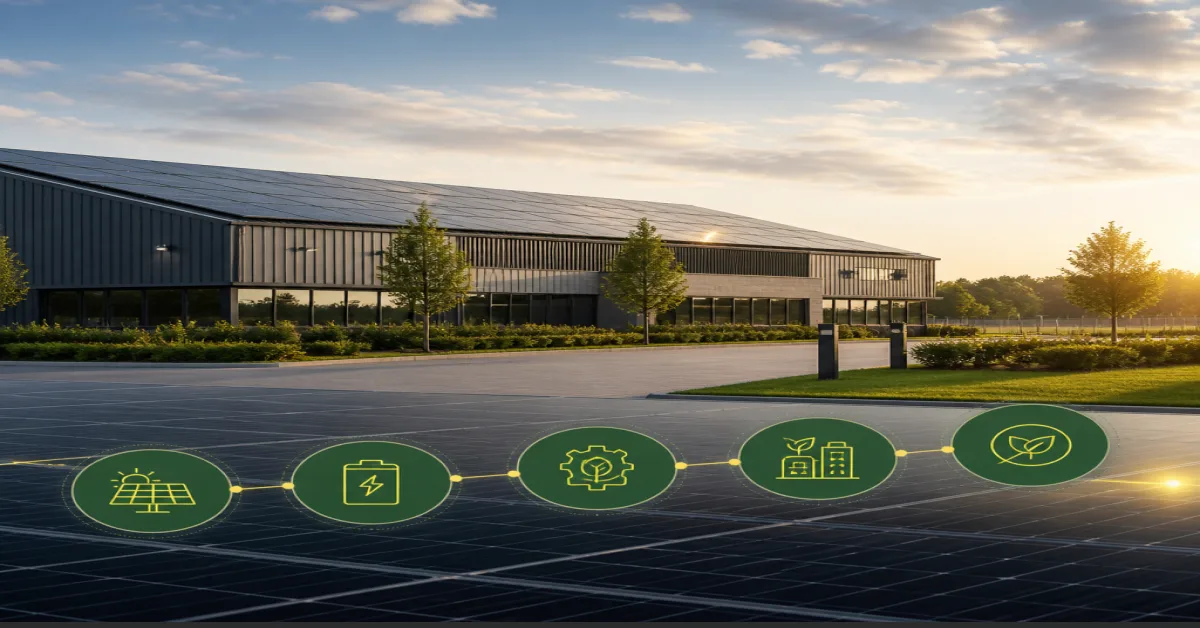
Net Zero Strategy2026
Net Zero Strategy: Start With Solar
Solar PV is the cheapest first step to net zero for commercial buildings. Plan explained.
What a commercial net zero strategy actually is
A business-risk framework built on inventory, targets, capital actions and disclosure — not a climate slogan.
Is: Sequenced Plan
A sequenced reduction plan built on a measured inventory, clear targets, capital actions, a residual emissions policy, and regular disclosure.
Is Not: Offsets First
Not buying offsets as a starting point, publishing unmeasured green claims, or treating efficiency-only savings as the end state.
Capital Sequencing
Deciding what you fund first so later steps — heat pumps, EV fleets, residual policy — are cheaper and reportable.
A commercial net zero strategy is a governed plan to cut emissions as far as practicable, handle residual emissions without greenwashing, and evidence progress for ESG, investors, and UK compliance. It is a business-risk framework, not a climate slogan.
Residual emissions are what remain after deep operational cuts, not a licence to delay action. For credibility with investors and frameworks like the Science Based Targets initiative (SBTi), reductions must be measurable and verifiable. The UK government’s 2050 net zero commitment is the policy context, but the commercial case rests on cost exposure, reporting burden, and compliance risk. The critical difference from generic frameworks that stop at "measure then reduce" is capital sequencing: deciding what you fund first so that later steps — heat pumps, EV fleets, residual policy — are cheaper and reportable.
Why solar PV is the first capital pillar, not a later renewables bullet
The only major measure that typically pays for itself over a 25-year life — site-specific, never free energy.
Scope 2
Material cut by displacing purchased electricity
25-Year
Capital asset return horizon, site-dependent
Headroom
Enables later heat pumps and EV fleets
For most commercial buildings, well-designed rooftop solar is the most cost-effective first major decarbonisation step because it is the only major measure that typically pays for itself over a long operating life, framed here as a 25-year financial return. This is always site-specific, never "free energy," and never a guaranteed payback.
1
Material Scope 2 cut: on-site generation directly displaces purchased electricity, a primary reporting line.
2
Cashflow character: solar behaves like a capital asset with a long return horizon, unlike consumable savings measures.
3
Headroom for electrification: the right roof and electrical design now supports later heat pumps and EV fleets.
4
Solar first if the roof and electrical path are viable and Scope 2 is material. Survey first if roof or electrical viability is unknown.
Energy efficiency still matters; LEDs and insulation are not dismissed, but they are a different class of investment. Off-site instruments like virtual PPAs are an adjacent option, yet on-site generation is the foundational pillar because it delivers a measurable, verifiable Scope 2 reduction that can support SBTi or B Corp-type submissions when properly documented. Competitor frameworks list "renewable energy" as step four; this page inverts that order because generation is the asset that funds and enables later heat, EV, and residual policy decisions.
How on-site solar cuts Scope 2 emissions (typically 40–70%)
Displaces Grid kWh
Scope 2 means emissions from bought electricity; on-site solar displaces grid kWh so the inventory falls.
Array-to-Load Ratio
The 40–70% range is a design outcome driven by array size relative to consumption — not inherent to solar. Two sites with "solar" can sit at opposite ends of that band.
Audit-Ready Data
When monitoring exports match SECR, CDP or voluntary templates, generation data becomes an audit-ready line item.
Scope 2 means emissions from the electricity a business buys; on-site solar displaces grid kWh, so the inventory falls. A typical commercial system can reduce Scope 2 by 40–70%, depending on array size relative to building consumption, not as a guarantee but as a working range.
The range is driven by the array-to-load ratio. This is the CFO-usable caveat: the percentage reduction is a design outcome, not an inherent property of solar. Generation and avoided-emissions data become an audit-ready line item when monitoring exports match reporting templates. This is process hygiene, not a certification promise. For detailed financial figures, see the commercial solar ROI guide. You can also use the commercial solar ROI calculator for a site-specific estimate of your potential savings.
ESOS Phase 3 and the UK regulatory case for acting now
An audit plus action plan is required — solar is implemented progress evidence. The regulatory and market pressures are why commercial solar demand is surging, reinforcing the case for early action.
What ESOS Asks For
A compliant energy audit and a written decarbonisation action plan for large UK undertakings.
What Solar Evidences
A tangible reduction measure, monitoring data for reporting, and a defensible position if plans become public. See how energy auditing and solar feasibility work in practice.
Reputational Hedge
Installed solar demonstrates follow-through on the written plan if future public reporting is mandated.
ESOS Phase 3 applies to large UK undertakings and requires an energy audit plus a decarbonisation action plan. The government has indicated future phases may involve public reporting of those plans, which is possible, not enacted law.
Installed solar is implemented progress evidence and a reputational hedge against inaction. It does not "satisfy ESOS" by itself, but generation and monitoring data demonstrate follow-through on the written plan. The distinction matters: the audit identifies opportunities; the action plan commits to them. Solar converts that commitment into a verifiable, operational asset. Supply-chain carbon questions and investor ESG expectations are adjacent pressures, not the core ESOS requirement.
Size solar for tomorrow’s electrification, not only today’s kWh
Roof Headroom
Physical capacity for additional panels if demand grows with heat and transport.
Electrical Capacity
Inverter headroom, switchgear, and grid connection headroom for later loads.
Scalable Monitoring
Metering that can accommodate new loads without rework.
Sequencing
Each investment reinforces the others rather than blocking them.
Storage Ready
Plan for battery storage as a next step in your future plan.
Model Interactions
Avoid undersizing through modelling interacting investments — solar × EV × heat × storage.
Electrifying heat and transport raises electricity demand; an array sized only to today’s load may need expansion. Installing adequate roof capacity and electrical infrastructure up front is typically cheaper and less disruptive than retrofitting later. Heat pumps, EV fleet charging, and battery storage are interacting loads, not isolated projects.
The design rule is expandability, not maximising today’s self-consumption in isolation. Bee Solar consultants can model solar × EV charging × heat pumps × storage to avoid undersizing and the costly retrofit that follows.
Solar vs insulation vs LED upgrades: ROI character and sequencing
All reduce cost and carbon, but they are not substitutes. To explore how these variables differ across industries, compare solar suitability by sector.
| Measure | Primary carbon lever | Typical role | Financial character | Sequencing note |
|---|---|---|---|---|
| Solar PV | Displaces purchased electricity (Scope 2) | First major generation asset | Long-life capital return, site-dependent | First when roof/electrical path is viable |
| Insulation | Reduces gas/electricity heating demand | Fabric efficiency, early-stage | Upfront cost, ongoing savings | Efficiency-first where fabric is grossly inefficient |
| LED upgrades | Reduces electricity for lighting | Quick win, low-regret | Short payback, consumable savings | Do first if lighting is outdated |
Insulation, LEDs, and solar all reduce energy cost and carbon, but they are not substitutes. None of the other listed measures match the 25-year financial return of a well-designed solar installation, presented as typical framing, not a universal law.
Site-specific variables decide the order: consumption profile, tariff, roof condition and structure, irradiation, and export arrangements. Solar first when the roof and electrical path are viable and Scope 2 is material; efficiency-first where fabric or lighting is grossly inefficient and solar is constrained. A survey decides, not a generic payback promise.
Portfolio-wide standardised installations
One installer, one monitoring stack — comparable KPIs and simpler reporting across ten or more locations.
Standardise
One installer and one monitoring stack for consistency across the portfolio.
Pilot Sites
First installations generate real data for the business case for later capex.
Scale
Use the same model across the remaining portfolio to benchmark and simplify procurement.
Standardising installer and monitoring platform across a portfolio reduces procurement friction, simplifies reporting, and creates comparable site KPIs. A staged rollout uses early sites to build the internal business case for later capex. Consistent generation data feeds Scope 2 templates, enables benchmarking, and reduces vendor interfaces for sustainability managers.
Some Bee Solar clients have rolled out across ten or more locations, an illustration of approach, not a performance claim. A common mistake is mixed kit that fragments datasets and breaks reporting comparability; standardisation prevents this at the procurement stage rather than repairing it later.
How Bee Solar positions solar inside your net zero roadmap
Solar positioned inside a broader roadmap — modelling EV, heat pumps and storage for Manchester and UK portfolios.
1
Enquiry
Discuss sites, loads and ESG reporting needs.
2
Site Survey
Free survey of roof, electrics and growth plans.
3
Model & Quote
Site-specific model plus itemised quotation.
4
Install & Monitor
Install and monitoring as scoped.
Bee Solar provides commercial solar positioned inside a broader net zero roadmap, with consultants modelling interactions with planned EV charging, heat pumps, and battery storage. The service is for sustainability managers and C-suite owners of ESG reporting and decarbonisation in UK commercial enterprises, including multi-site portfolios.
It solves sequencing risk, weak Scope 2 evidence, undersizing, and fragmented portfolio data. The expected outcome is a site-specific model and a detailed, itemised quotation after a free site survey, not promised kWh, payback, or a guaranteed "lowest-cost pathway." The view that early solar leads to the lowest-cost full decarbonisation is a strategic position, not a proven law.
Yield, Scope 2 percentage, and payback are site-specific; roof or electrical constraints can make solar not first or not viable. Complexity is driven by number of sites, load-growth plans, and building constraints. Risk reduction comes from measurable Scope 2, audit-ready monitoring, and portfolio consistency, without invented awards or named case studies. Bee Solar is based in Manchester and Greater Manchester. For the next step, request a free site survey and itemised commercial quotation.
Process: enquiry → site survey → model interacting investments → itemised quote → install and monitoring as scoped.
Frequently Asked Questions
What is a net zero strategy for business?
A net zero strategy for business is a governed plan to cut emissions as far as practicable, handle residual emissions responsibly, and evidence progress for ESG, investors, and UK compliance. It requires a measured inventory, clear targets, capital actions, a residual policy, and disclosure.
Why start a net zero strategy with solar rather than other energy measures?
Start with solar because it is the only major decarbonisation measure that typically pays for itself over a long operating life, framed as a 25-year return, while also delivering a material Scope 2 cut and enabling later electrification. Efficiency measures like LEDs and insulation matter but have a different financial character and should not delay the first generation asset.
How does commercial solar reduce Scope 2 emissions, and why is the range 40–70%?
Commercial solar reduces Scope 2 emissions by displacing the grid electricity a business buys. The 40–70% range depends on array size relative to building consumption, so two sites with solar can sit at opposite ends of that band. It is a typical range, not a guarantee.
What does ESOS Phase 3 require, and how does solar relate to the decarbonisation action plan?
ESOS Phase 3 applies to large UK undertakings and requires an energy audit plus a decarbonisation action plan. Installed solar is implemented progress evidence that demonstrates follow-through on that plan. Future phases may mandate public reporting, which is indicated but not yet law.
Should we size solar for current electricity use or for future heat pumps and EV fleets?
Size for future electrification. An array sized only for today’s load may need expansion when heat pumps and EV fleets arrive. Installing adequate roof capacity and electrical infrastructure up front is cheaper and less disruptive than retrofitting later.
How does solar ROI compare with insulation or LED upgrades?
Solar has a longer financial return character, typically framed as a 25-year asset, while LEDs and insulation offer quicker but smaller savings. They are not substitutes; solar is the first major generation asset, and efficiency measures handle fabric and lighting. Site-specific variables like consumption profile, tariff, and roof condition decide the order.
Why standardise solar installations across a multi-site portfolio?
Standardising on one installer and monitoring platform reduces procurement costs, simplifies reporting, and creates comparable site KPIs. A staged rollout uses early sites to build the business case for later capex and avoids mixed kit that fragments datasets.
Are offsets a valid starting point for a corporate net zero strategy?
No. Offsets are not a valid starting point. A credible strategy prioritises deep operational cuts first, with offsets only for residual emissions after those cuts are made. On-site solar provides a verifiable Scope 2 reduction that offsets cannot replace.
What should we expect from a Bee Solar site survey and quotation?
A Bee Solar site survey produces a site-specific model and a detailed, itemised quotation. Consultants model how solar interacts with planned EV charging, heat pumps, and battery storage. The outcome is not a guaranteed payback but a defensible investment case based on your load and roof data.
Is there an official set of "five principles" of net zero, and which companies have net zero targets?
There is no official "five principles" standard. A practical framework maps to measure, reduce, residual policy, governance, and disclosure. Many firms set SBTi-aligned targets, but there is no authoritative public leaderboard; target-setting practice matters more than a named list.
Plan Your Next Solar Project
Put what you have read into practice. Request a free site survey and receive a detailed, itemised quotation for your commercial solar project.
Request A Free Quote