
Commercial Solar Installation UK | Bee Solar
Turnkey commercial solar for warehouses, factories and offices. MCS-certified, 25-year warranties.
What's Covered on This Page
- Ballasted Frames on Manchester’s Flat Commercial Roofs
- Daytime Business Loads vs Solar Peaks Across Greater Manchester Sites
- Sector Paths: Schools (Salix), Hospitals (G99), and Live Operations
- Manchester Weather Is Not the Blocker: Irradiation, Yield Bands, Design
- Installation Programme: Energy Audit, DNO/G99, Scheduled Roof Works, Commissioning
- Aftercare in Manchester: Monitoring, Maintenance, and ROI Protection
- Book a Commercial Solar Survey in Manchester
- Frequently Asked Questions
Need Commercial Solar Installation Manchester?
0161 570 0596
Get A Free Quote. Bee Solar is ready to help.
Ballasted Frames on Manchester’s Flat Commercial Roofs
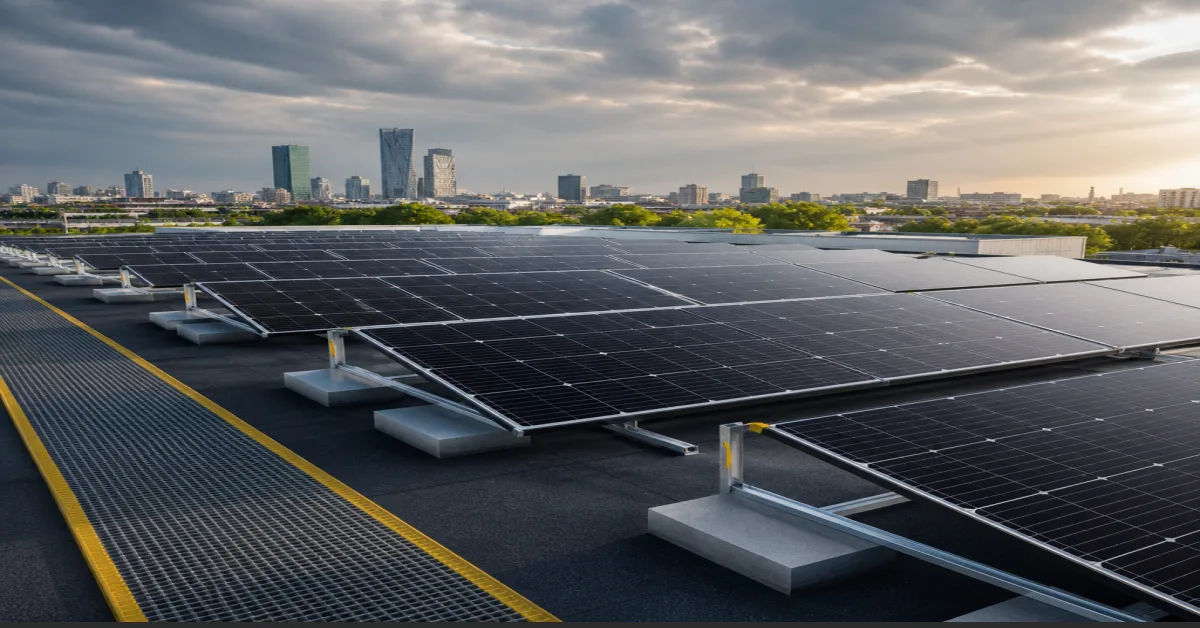
Ballasted frames are weighted, non-penetrating mounts that hold commercial PV rows on flat roofs without routinely piercing the waterproof membrane. This is the default mounting method for most commercial installations across Greater Manchester because it protects the roof fabric while allowing precise control over panel angle and layout.
Manchester’s commercial building stock is dominated by large flat decks, from Trafford Park warehouses to Piccadilly and Spinningfields offices and Ancoats retail units. These roofs suit ballasted systems because panels can be set at an optimal tilt and orientation, spaced in rows to prevent inter-row shading, and laid out with access aisles for maintenance. The flexibility of a flat roof means the array is designed around your roof’s exact dimensions, not constrained by a fixed pitch. Tilt angles are typically set between 5° and 15° to balance yield against wind uplift, and row spacing is calculated to minimise shading losses during winter months when the sun is lower.
Before any design is finalised, a structural survey confirms the roof can carry the additional load. Concrete decks and lightweight steel with single-ply membranes behave differently, and wind uplift affects ballast mass requirements. On some Trafford Park roofs the structure has looked viable but needed reinforcement; in a few cases, we have declined projects because the roof was unsuitable. That assessment happens before you commit to anything. Where a roof fails the load assessment, options include reinforcement or, if that is not cost-effective, an honest recommendation to wait.
Rooftop commercial systems under 1MW generally fall under permitted development, though DNO notification and potentially G99 approval are still required. These are managed as part of the process, not left for you to chase.
Book a free survey to confirm your roof’s loading capacity and get a ballasted array design. Call 0161 570 0596.
Non-Penetrating
Weighted frames protect the waterproof membrane with no routine piercing.
5°–15° Optimised Tilt
Precise angle and row spacing to cut shading and balance wind uplift.
Survey First
Structural and load assessment before design – honest go / no-go call.
Daytime Business Loads vs Solar Peaks Across Greater Manchester Sites
Commercial payback in Manchester is driven by how much of the generated power you use on site during daylight hours, not by exporting electricity to the grid. Solar generation peaks around midday, which aligns directly with the operating hours of most commercial properties, making self-consumption the core of the financial case.
| Site Type | Typical Daytime Load | PV-Only vs PV + Battery Cue |
|---|---|---|
| Factories | Machinery, lighting, compressed air | PV-only usually sufficient if load is daytime-heavy |
| Warehouses | Lighting, forklift charging, office areas | PV-only if overnight load is minimal; battery only if evening shift is significant |
| Offices | HVAC, IT, lighting, 9–5 operation | PV-only is a strong match; battery optional for evening HVAC |
| Retail | Refrigeration, lighting, long trading hours | PV + battery can extend self-consumption into evening trading |
| Cold Storage | 24/7 refrigeration | PV + battery if night-time refrigeration load is modelled; otherwise grid reliance remains at night |
This table is a general guide. For more detail on how each building type is assessed, see our specific guidance on solar for Manchester retail sites and solar for cold storage facilities. Self-consumption across retail-class sites typically lands in the 70–85% range as a sector figure, not a universal guarantee. Export tariffs pay far less than the cost of buying from the grid, so on-site use comes first. The grid stays in the model; batteries are only justified for surplus generation, peak shaving, or overnight load. Sizing the array to fill the entire roof by default can weaken ROI compared to matching the system to your half-hourly demand profile. A 9–5 office and a 24-hour cold store will justify very different array sizes even on identical roof footprints.
Sector Paths: Schools (Salix), Hospitals (G99), and Live Operations
Schools and hospitals are not standard warehouse installs; they require additional process, funding routes, and compliance steps that are scheduled, not rushed. If your project falls into one of these categories, the pathway is different and needs specialist handling.
Schools: Salix Finance and Holiday Windows
Schools have large, unshaded flat roofs and daytime loads that align with generation. Installation is scheduled around holiday windows and safeguarding protocols. Salix Finance is a named funding route for maintained schools and academies, enabling zero-capex projects. Eligibility is confirmed during the audit stage. The application is made after the audit confirms the project is viable, and the install is planned to avoid term-time disruption.
Hospitals: G99 Applications and Phased Access
Hospitals require NHS-grade electrical tie-ins and phased rooftop access around clinical operations. Larger or more complex arrays typically need G99 applications, and the estates team must be briefed before commissioning. This is a structured process, not a quick fit. Phased access means roof works are broken into scheduled windows so wards and energy supplies are never disrupted mid-procedure.
Other High-Constraint Sites
Stadiums need installs scheduled around event calendars, with canopies offering extra capacity. Stadium solar installations often have unique structural and planning considerations. Hotels need occupancy-sensitive planning for kitchens, HVAC, and laundry loads. Warehouses, offices, factories, retail, and cold storage follow the load-alignment logic covered above.
Manchester Weather Is Not the Blocker: Irradiation, Yield Bands, Design
Modern PV responds to daylight, not constant direct sun, and Manchester receives roughly 1,200 hours of sunshine a year, which is enough for commercial viability. Cooler temperatures also improve panel efficiency compared to hotter climates, meaning Manchester’s mild summers can actually support stable year-round generation.
What the numbers show:
- A typical 100kWp warehouse-class system in Greater Manchester generates between 85,000 and 95,000 kWh per year.
- On overcast days, panels still produce 10–25% of their rated capacity.
- Payback for Manchester businesses typically sits in the 4–6 year band when self-consumption and tariff are optimised.
What matters more than sunshine hours are orientation and tilt, shading from nearby structures, how much generation you use on site, and your electricity tariff. Design beats climate. Poor design, not cloud cover, is the usual cause of underperformance. Installations across Ancoats, Salford Quays, and the Etihad Campus corridor demonstrate that viability is not a geography problem. A 5° tilt with no shading will outperform a perfect orientation behind a neighbouring building. These yield bands hold up in practice, as shown in a warehouse solar case study.
Installation Programme: Energy Audit, DNO/G99, Scheduled Roof Works, Commissioning
The typical survey-to-switch-on programme is six to eight weeks, with physical roof works taking three to five days for a standard commercial roof. Larger or multi-building projects take longer. The DNO wait is usually the critical path, and it varies with the network operator’s workload. It is never “soon” or “quickly”; it is phased and scheduled. Planning for DNO as the longest phase is what keeps the rest of the programme realistic.
Energy Audit First
Bills, half-hourly data, peaks vs daylight, capacity and shading. See how an energy audit shapes system sizing on a real project. Without half-hourly data, you are guessing at size.
Site & Structural Survey
Roof condition, loading capacity, and access confirmed by physical inspection.
Demand-Matched Design
Sized to half-hourly load, not roof area – e.g. a manufacturing site's solar and battery setup.
DNO & Planning Checks
DNO in all cases, G99 for larger arrays – see a Manchester cold storage project.
Scheduled Install
Scaffolding and roof works coordinated around operating hours.
Commissioning
Circuit tests, monitoring configuration, final DNO paperwork. Generation from switch-on.
Self-consumption ratios are an audit output, not a fixed assumption. Capex versus funded options are discussed after the yield model is established, not before. This sequencing ensures you choose a finance route based on real projected returns, not a generic sales figure.
Book a free survey or quote by calling 0161 570 0596.
Aftercare in Manchester: Monitoring, Maintenance, and ROI Protection
Every commercial installation includes real-time monitoring so generation, self-consumption, and export are visible from day one. This is not a gadget; it is how you protect the return on your investment. Without monitoring, a faulty string can sit unnoticed for months while your payback period stretches.
- Live generation data for each string of panels
- Historical performance trends
- Grid export volumes and self-consumption ratios
- Fault alerts for inverters or panel drops
Our team reviews system data remotely. If something looks irregular, we contact you, often before you notice it. A fault left undetected for three months can cost thousands in lost generation. Monitoring separates weather dips from genuine faults; a week of overcast skies shows a predictable output dip, while a single string dropping to zero is a hardware issue that needs attention. In Trafford Park, particulate buildup from industrial activity can trigger cleaning when output drops below a threshold; the data tells us when that service is justified, underlining the need for ongoing solar maintenance and monitoring.
Book a Commercial Solar Survey in Manchester
Bee Solar provides commercial PV surveys, design, DNO/G99 management, scheduled install, commissioning, and monitoring for Manchester and Greater Manchester commercial properties. Call 0161 570 0596 for a free, no-obligation survey and quote.
You will get a flat-roof ballast assessment where the structure allows, an array sized to your actual demand, and an honest recommendation if your roof is unsuitable. The survey confirms structure, load match, and the DNO path. It is not a hard sell for a roof-filling array. If your roof cannot support the weight or your demand profile does not justify solar, you will be told clearly and given the reasons.
Frequently Asked Questions
Common Questions About Commercial Solar Installation in Manchester
Do commercial solar installations in Manchester need planning permission?
Most rooftop commercial installations in Manchester do not require full planning permission. Under permitted development rules, systems under 1MW on commercial buildings are generally exempt. We handle the DNO application and any G99 notifications on your behalf. Buildings in conservation areas may have additional requirements, which are checked during the survey.
How long does a commercial solar installation take from start to finish?
The full process from survey to switch-on typically takes six to eight weeks. Physical installation on the roof usually takes three to five days. The longest phase is DNO approval, which depends on the network operator’s workload. Larger or multi-building projects take longer and are scheduled accordingly.
Will solar panels actually generate enough power in Manchester’s weather?
Yes. Solar panels respond to daylight, not just direct sunshine. Manchester receives around 1,200 sunshine hours per year, and cooler temperatures improve panel efficiency. A typical 100kWp warehouse system can generate between 85,000 and 95,000 kWh annually. Even on overcast days, output reaches 10–25% of rated capacity.
Is my commercial roof strong enough to support solar panels?
This is confirmed on every project before design is finalised. Flat commercial roofs range from concrete decks to lightweight steel with single-ply membranes. A structural survey verifies load capacity. If a roof needs reinforcement or is unsuitable, we identify it early. This has happened on some Trafford Park warehouses.
What happens on the day your team arrives to install the system?
The team arrives with scaffolding, mounting frames, panels, and cabling. Access is set up without blocking your business operations. Panel rows are spaced to avoid shading, electrical connections are made to the inverter and metering, and at the end, every circuit is tested and monitoring is configured. Generation begins from switch-on.
Can a flat-roofed office or retail unit in Manchester support a large enough solar array to make a difference?
Yes. Flat roofs allow panels to be set at the exact tilt for maximum output, which pitched roofs do not. A 10,000 sq ft flat roof can often support a 100kWp system or larger. We work across office blocks near Piccadilly and retail units towards Ancoats. Larger arrays mean faster payback and a bigger reduction in electricity bills.
Should we size the array to the whole roof or to our electricity demand?
Size the array to your electricity demand, specifically your half-hourly daytime load profile. Filling the roof by default can reduce ROI because more of the generation gets exported at lower rates. The energy audit determines the correct size by matching generation to your actual usage patterns.
Do we need battery storage to benefit from commercial solar, or will we still rely on the grid?
You do not need battery storage to benefit. Most commercial sites see strong returns from PV-only by maximising daytime self-consumption. Batteries are only justified for surplus generation, peak shaving, or overnight loads like cold storage. You will still rely on the grid outside generation hours; energy independence without storage is not realistic.
Get Your Free Solar Quote
Our engineers will visit your site for a free survey and deliver a detailed proposal within 48 hours.
0161 570 0596
No obligation. Response within 24 hours.