
Stadium Solar Panels Manchester | Bee Solar
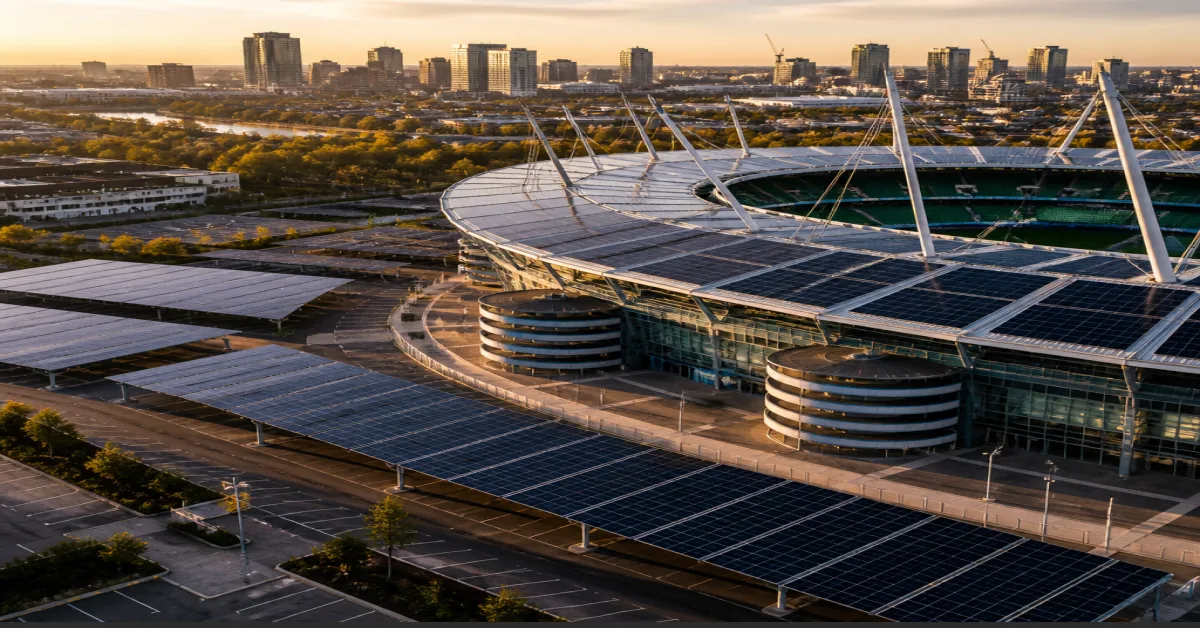
Massive roofs plus car-park canopies. High-capacity grid connections handled (G99/G100).
£106k/yr
Typical savings (500 kWp + BESS)
5.5 yr
Modelled payback with battery
175 tCO2e
Annual carbon offset
62%
Non-matchday baseload offset
What's Covered on This Page
- Roof Spans vs Car Park Canopies for Manchester Stadiums
- How BESS Couples to Floodlight and Matchday Demand
- Planning Permission and Grid Connection for Manchester Venues
- Non-Disruptive Installation During an Active Sports Season
- The Commercial Case for Stadium Solar in Greater Manchester
- Site-Specific Design: Structure, Shading, and Energy Mapping
- Monitoring, Maintenance, and Performance After Commissioning
- Frequently Asked Questions
Need Solar for Sports Stadiums?
0161 570 0596
Get A Free Quote. Bee Commercial Solar is ready to help.
Roof Spans vs Car Park Canopies for Manchester Stadiums
Stadium solar systems use unused roof spans and/or car park canopies to generate on-site power for baseload and event peaks; Bee Solar designs both as a commercial installation, not a stock product. A typical commercial building may offer around 500 m² of usable roof, while a sports venue often provides roughly ten times that area, though the truly usable area remains survey-dependent.
Modern stand roof structures are engineered for significant loads, which often means panel installation requires no additional steelwork. Roofs do, however, carry drainage channels, floodlight cabling, and communication aerials that must be mapped before mounting begins. Panels are typically placed on discrete rear slopes so pitch and broadcast camera sightlines are not compromised. This matters in Manchester because broadcast cabins at venues across the city have strict sightline agreements, and a poorly placed array can trigger renegotiation.
Roof-First Baseload
Discrete rear slopes preserve broadcast views while delivering primary generation with no added steelwork.
Canopy Capacity + EV
2,000 spaces can support 300-600 kWp plus matchday EV charging and covered parking.
Sightline Safe
Mapping of drainage, floodlight cabling and aerials avoids broadcast renegotiation.
Both-And Strategy
Roof where load-capable, then canopies to add capacity, cover and fan experience.
Car park canopies provide a second mounting surface. An illustrative 2,000-space car park can support a 300 to 600 kWp capacity band as a planning figure, but only a survey will confirm the real number. Canopies also integrate with EV chargers for matchday visitors, adding a revenue and fan-experience layer that roof-only arrays cannot offer. Covered parking also reduces ice on walkways during winter fixtures, a small operational gain that facility teams notice.
Some venues run a combined array when one surface is constrained. A Wythenshawe-style community stadium with a smaller roof may rely more on canopies, while a Sportcity or Etihad Campus-style roof profile offers greater span. The commercially sensible choice is often both-and: roof first where load-capable, then canopies to add capacity and covered parking. This is not a copy of the US "parking structure" PR approach; it is a load, access, and generation decision for your specific site.
| Decision factor | Roof arrays | Car park canopies |
|---|---|---|
| Structure / load | Modern stands often load-capable with no added steelwork | New freestanding structure, independent of stadium fabric |
| Disruption | Roof access via back-of-house, midweek crane lifts | Install around car park operation; can be sectioned |
| EV integration | No direct EV benefit | Integrates with matchday EV charging |
| Visuals / sightlines | Discrete rear slopes preserve broadcast views | Adds covered parking, visible but low-level |
| Generation role | Primary baseload generation surface | Secondary capacity, adds covered parking and EV |
Choose roof-first where stands are load-capable and you can access the rear slopes cleanly. Add canopies when you need extra capacity, covered parking, or EV infrastructure and the roof cannot deliver the full target alone.
How BESS Couples to Floodlight and Matchday Demand
BESS stores daytime generation and discharges for evening floodlight and event peaks when the array is not producing. This makes battery storage as an operational continuity tool for evening kick-offs, not a sustainability accessory.
A typical modern stadium runs a non-matchday baseload of 400 to 600 kWh/day as a checklist figure, not a figure that applies to every site. That baseload covers security, maintenance, and facility management. On matchdays, demand spikes sharply with HVAC, hospitality, displays, turnstiles, and floodlights all drawing at once. The problem is timing: the array generates in the afternoon, but the floodlights switch on after sunset. For evening fixtures in Manchester's winter months, that gap can be four or more hours.
The energy path works like this:
Daytime Charge
Daytime generation powers baseload and charges the battery.
Evening Peak
Floodlight and hospitality demand rises as solar output falls.
Peak Discharge
Battery discharges into peak, reducing grid draw at worst tariff window.
SEG Export
Surplus after on-site use exports through Smart Export Guarantee.
- Daytime generation powers baseload and charges the battery.
- Evening floodlight and hospitality demand rises as solar output falls.
- The battery discharges into that peak, reducing grid draw at the worst tariff window.
- Any surplus generation after on-site use exports through the Smart Export Guarantee.
Peak-shave logic means a modelled system can cut floodlight demand charges by up to 55% over a season, but that figure is survey-dependent and site-specific. The saving comes from avoiding the highest-cost half-hour periods, which for most Manchester venues fall between 16:00 and 20:00 during winter fixtures. This same peak-shaving principle is applied to slashing peak demand charges in manufacturing, where the financial mechanic of avoiding high-tariff windows is equally critical. A Thames Valley data centre project at 1 MWp plus 1 MWh demonstrates the peak-shave principle at commercial scale and is offered as an analogue, not a stadium trophy.
For a stadium, the decisive point is that afternoon surplus becomes evening kick-off power. Systems that stop at "green lighting" miss this operational value entirely. An NHS hospital solar and battery project further illustrates how BESS ensures operational continuity during high-demand periods, a high-trust analogue for critical infrastructure.
Planning Permission and Grid Connection for Manchester Venues
Most Manchester stadium and arena arrays qualify as permitted development if panels protrude no more than 200mm and the building is not listed. Conservation areas and Manchester flight paths add extra local planning authority scrutiny; projects near the Etihad Campus area, for example, have required further LPA consultation before installation. Venues within the Manchester City Council boundary may also face additional design-code review even where permitted development applies.
The grid connection process with Electricity North West follows a defined sequence:
ENW Enquiry
Preliminary enquiry to confirm available substation capacity.
Formal Application
Single-line diagrams and load calculations submitted.
Connection Offer
Offer typically within 45-65 working days above 1 MW.
G99 Commissioning
Accept offer, coordinate works and witness testing.
- Submit a preliminary enquiry to ENW to confirm available capacity at your substation.
- Prepare a formal connection application with single-line diagrams and load calculations.
- Receive a connection offer, typically within 45 to 65 working days for systems above 1 MW.
- Accept the offer and coordinate the physical connection works.
- Complete final commissioning and G99 witness testing before the system goes live.
The usual delay is grid capacity, not planning. Some substations around East Manchester, Sportcity, and Eastlands are strained by nearby developments including residential schemes and business parks that have increased local demand. There is no benefit in designing a 1.5 MW system if the local grid can only accept around 800 kW without expensive reinforcement. A preliminary enquiry before locking the array size is the mistake-avoidance rule.
If reinforcement is needed, the cost is weighed against projected savings. Some venues phase their installation to avoid triggering upgrades, a pragmatic approach Bee Solar has implemented across multiple projects. Bee Solar manages DNO paperwork from the outset through its commercial installation and design service, so the venue's own engineering team is not pulled into connection admin.
Non-Disruptive Installation During an Active Sports Season
Yes, stadium solar can be installed during the season if work is phased around the fixture list, concerts, and safety zones, with midweek and off-days prioritised. This is the primary objection from venue operators, and it is removable through structured programme management.
The installation sequence at a live venue runs as follows:
Fixture Calendar
Phased programme built around fixtures, concerts and events.
Back-of-House Compound
Secure compound in service area for materials and kit.
Rails + Crane Lifts
Section-by-section rails, midweek crane lifts for panels.
Connect + Commission
Distribution board connection, testing and DNO notification.
- Agree a phased installation calendar built around fixtures, concerts, and booked events.
- Secure a back-of-house compound for materials and equipment, usually in a service area or car park.
- Install structural mounting rails section by section across roof or canopy areas.
- Crane panels into position on off-days, typically midweek when foot traffic is lowest.
- Connect the array to the existing distribution board and metering setup.
- Commission, test, and notify the DNO before the system becomes operational.
Most Manchester stadium installations take 8 to 14 weeks depending on array size and roof access. A dedicated project manager coordinates with your operations team, security protocols, and any third-party contractors already on site. Full CSCS accreditation and CDM 2015 compliance apply to every commercial project, with method statements produced for crane lifts near stands or public walkways. For venues with concerts booked between fixtures, the programme is re-sequenced around load-in days, when the stage build occupies the same access routes.
Stadium roofs near Eastlands or the Etihad Campus often carry complex drainage channels, floodlight cabling, and communication aerials. The survey team maps every obstruction before the lift, which is where live-venue logistics become the hard part, not the panels themselves. Spectator zones and steward briefings are included in the method statements so matchday staff know what work is happening and where.
The Commercial Case for Stadium Solar in Greater Manchester
Large roofs and car parks, combined with year-round baseload and matchday spikes, make stadiums high-ticket solar plus storage sites where on-site generation cuts procurement versus buying all power from the grid. This financial driver relies on the same principle as providing round-the-clock baseload for cold storage, where 24/7 power is a non-negotiable operational requirement. The financial case rests on measurable lines, not environmental messaging.
Business rates relief on renewable assets is a finance line that is often missed. Large systems may qualify, but eligibility must be verified with your surveyor or finance team; no universal percentage should be assumed. The relief applies to the solar array itself, not the building, and the valuation is typically based on the rateable value of the renewable equipment. According to Solar Energy UK, commercial systems above 100 kW can reduce grid dependency by 30 to 40% in year one, a figure that should be attributed rather than inflated.
A modelled 500 kWp system with BESS illustrates the scale of the opportunity at typical, survey-dependent levels:
£106,000 per year in typical savings
5.5-year modelled payback with battery
62% of non-matchday baseload offset
175 tCO2e annual carbon offset
- £106,000 per year in typical savings
- 5.5-year modelled payback with battery
- 62% of non-matchday baseload offset
- 175 tCO2e annual carbon offset
These figures are typical modelled outcomes for a 500 kWp plus BESS configuration, never a guaranteed payback. A site-specific survey using half-hourly consumption data, local cloud cover, and shading analysis produces the real numbers. Manchester's climate is a financial hygiene factor: generation comes from daylight including overcast conditions, and models use local cloud and shading data rather than US irradiance assumptions. A venue in Sale will see a slightly different generation profile to one in Oldham due to local weather patterns and shading from surrounding buildings.
Visibility for sponsors, councils, and fans is secondary to pounds and process, but it remains a genuine secondary benefit. Energy consulting maps consumption before any kit is specified, so the array is sized to the venue's actual load profile rather than a generic benchmark.
Site-Specific Design: Structure, Shading, and Energy Mapping
Every venue needs a site-specific design; Bee Solar's sequence is structural survey, energy demand mapping, shading and orientation analysis, DNO planning, then layout and projected generation. A 10,000-seat arena near Sportcity has a different roof profile, orientation, and energy demand pattern to a community stadium closer to Wythenshawe, and both differ from a modern Etihad Campus-style structure.
The design sequence follows a clear order:
Structural Survey
Roof type, load capacity and mounting options assessed.
Energy Mapping
Consumption aligned to matchdays and off-season.
Shading Analysis
Towers, overhangs and buildings modelled year-round.
DNO + Layout
Early grid application then full layout and generation.
- Structural survey: assess roof type, load-bearing capacity, and mounting options. Steel-framed stands and concrete terracing support panel weight differently.
- Energy demand mapping: analyse consumption data aligned to matchdays, event schedules, and off-season usage to size the system for baseload and peaks.
- Shading and orientation: account for floodlight towers, grandstand overhangs, and nearby buildings, modelling shadows across the year.
- DNO and grid connection planning: submit applications early to prevent delays.
- Layout design: produce a full system layout showing panel placement, inverter locations, cable routes, and projected generation.
Unused surfaces managers often do not count can change capacity more than adding panels to the main stand. South-facing hospitality suites, flat-roofed equipment buildings, and covered walkways between stands all contribute to the array. A maintenance shed roof that faces south may add 20 to 40 kWp that the main stand cannot carry. Spectator safety, listed fabric, and restricted access windows are folded into the design before equipment arrives. The project is delivered through commercial installation from survey to G99 commissioning.
Monitoring, Maintenance, and Performance After Commissioning
After G99 commissioning the array generates immediately; remote monitoring tracks generation, consumption, and export, with Bee Solar watching the same feed. A well-monitored system sustains strong returns, while a neglected one underperforms, and the gap is visible across Manchester sites.
For venues near Sportcity or the Etihad Campus, dust and debris from nearby roads settle on panels, and bird soiling adds to the load. Venues close to the M60 or major A-roads see the same effect. A clean, well-maintained array can recover 5 to 15% of lost output compared to a neglected one, a meaningful money line over a 25-year lifespan. On a 500 kWp system, 10% lost output is roughly £10,000 per year in foregone generation at typical commercial rates.
The annual service scope covers:
Visual inspection of all panels, fixings, and cable runs
Electrical testing of inverters, isolators, and DC string performance
Panel cleaning to remove grime, bird droppings, and organic buildup
Mounting system checks to confirm structural integrity
- Visual inspection of all panels, fixings, and cable runs
- Electrical testing of inverters, isolators, and DC string performance
- Panel cleaning to remove grime, bird droppings, and organic buildup
- Mounting system checks to confirm structural integrity
- Performance report comparing actual output against projected figures
Surplus electricity exports through the Smart Export Guarantee, and the facilities team gets a walkthrough of the monitoring platform so they understand normal performance and can flag anomalies without calling first. Aftercare is a 25-year money line, not a ribbon-cutting afterthought. Inverter replacement is typically scheduled around year 10 to 12, and the performance report flags this in advance so the cost lands in the right budget cycle.
Adjacent Commercial Proof and How to Enquire
Bee Solar is a sensible Greater Manchester provider for stadium-scale solar due to Electricity North West fluency, live-venue CDM experience, honest survey caveats, and ongoing monitoring support. Proof of capability comes from adjacent commercial projects, clearly labelled rather than presented as stadium case studies.
120 kWp Retail Carport
Leeds carport covering 80 bays, powering common areas and EV chargers — a retail carport analogue for stadium canopies.
1 MWp + 1 MWh BESS
Thames Valley data centre offsets 55% daytime cooling — see the Thames Valley data centre project.
The Yorkshire Retail Park carport in Leeds installed 120 kWp of solar canopies, providing covered parking for 80 vehicles while powering common areas, EV charging stations, and tenant supply. This is a retail carport analogue for stadium canopies, showing the covered parking and EV integration model in operation, and you can explore the full commercial retail solar solution.
The Thames Valley data centre project in Slough delivered a 1 MWp rooftop array paired with a 1 MWh lithium iron phosphate battery. It offsets 55% of daytime cooling demand, cuts peak demand charges, and extends UPS bridge time. This direct link to the Thames Valley data centre project provides the full case study as a data-centre analogue for scale and BESS behaviour, not a stadium installation, but it demonstrates the peak-shave principle at the right scale.
To move forward, book a free site survey. The survey takes approximately 45 minutes at your venue, with a report delivered within 5 business days. Call 0161 570 0596 or Get a Free Quote. Energy consulting using half-hourly data comes first, so the array is sized against your actual consumption profile rather than assumptions.
Readiness indicators include large roof areas on stands or training facilities, year-round baseload from offices and hospitality, evening floodlight demand that storage can peak-shave, car park space for canopies, and net-zero or sponsorship pressure. These conditions make a venue a candidate for survey, but every design and payback figure follows the site visit.
Frequently Asked Questions
Frequently Asked Questions
This page covers retrofit energy systems for existing venues, not how to build a 60,000-seat stadium.
Can a Manchester stadium install solar panels during the season without disrupting events?
Yes, installation work is scheduled around the fixture list and event calendar. Most rooftop work happens during off-season windows or midweek gaps between events. Access restrictions, spectator safety zones, and matchday operations are factored in before any equipment arrives on site. Early planning is the key to working around a live venue calendar.
Does Manchester's weather affect how much energy a stadium solar system actually generates?
Manchester receives enough daylight to make large-scale solar worthwhile. Solar panels generate power from daylight, not just direct sunshine, and overcast days still produce meaningful output. Shading and orientation analysis accounts for Manchester's typical cloud cover, so projected generation figures reflect local conditions rather than sunnier climates.
Do stadium solar installations in Manchester need planning permission?
Most stadium solar installations qualify under permitted development rights and do not need a formal planning application. Panels must not protrude more than 200mm from the roof surface, and the building must not be listed. Venues near conservation areas or flight paths may face additional scrutiny. A site assessment confirms what approvals are needed before design work begins.
How long does the grid connection process take for a large stadium solar system?
For systems above 1 MW, Electricity North West typically issues a connection offer within 45 to 65 working days after a formal application. The preliminary enquiry, single-line diagrams, and load calculations are handled by Bee Solar on the venue's behalf. The DNO timeline runs independently of the installation schedule, so grid applications are submitted as early as possible.
Can a stadium car park be used for solar generation as well as the roof?
Yes, car park canopies are a strong second mounting option. They add significant generation capacity alongside a rooftop array and integrate with EV charger installation for matchday visitors. Car park potential is included in every site assessment, and a 2,000-space car park can support a 300 to 600 kWp capacity band as an illustrative planning figure requiring survey.
What happens after the solar system is installed and commissioned at our venue?
Once the system passes G99 commissioning, it begins generating immediately. Monitoring tracks output against energy consumption in real time, and surplus electricity exports through the Smart Export Guarantee for additional income. The facilities team receives a walkthrough of the monitoring platform so they understand normal performance and can flag anything unusual.
Ready to Explore Solar for Your Stadium?
We will survey your stands and car parks, model your matchday savings, and present a tailored proposal — no obligation.
Typical survey takes 45 minutes. Report delivered within 5 business days.