
Warehouse Solar Panels Manchester | Bee Solar
Flat warehouse roofs cut bills up to £58k/year. 100 kWp installed in 5–8 working days.
£58k/yr
Illustrative annual savings (250 kWp)
3.8 yr
Average payback period
78 tCO2e
Annual carbon offset
85%
Daytime demand offset
What's Covered on This Page
- Why Manchester Warehouse Roofs Are an Underutilised Generation Asset
- Whether Your Warehouse Roof Can Take Solar Panels
- How Solar Installation Works on a Manchester Warehouse
- Rooftop vs Ground-Mount for Greater Manchester Distribution Sites
- Connecting Solar, Battery Storage and Workplace EV Charging as One Design
- Monitoring and Protecting the Warehouse Solar Asset
- Solar Readiness and How to Enquire
- Frequently Asked Questions
Need Solar for Warehouses?
0161 570 0596
Get A Free Quote. Bee Commercial Solar is ready to help.
Why Manchester Warehouse Roofs Are an Underutilised Generation Asset
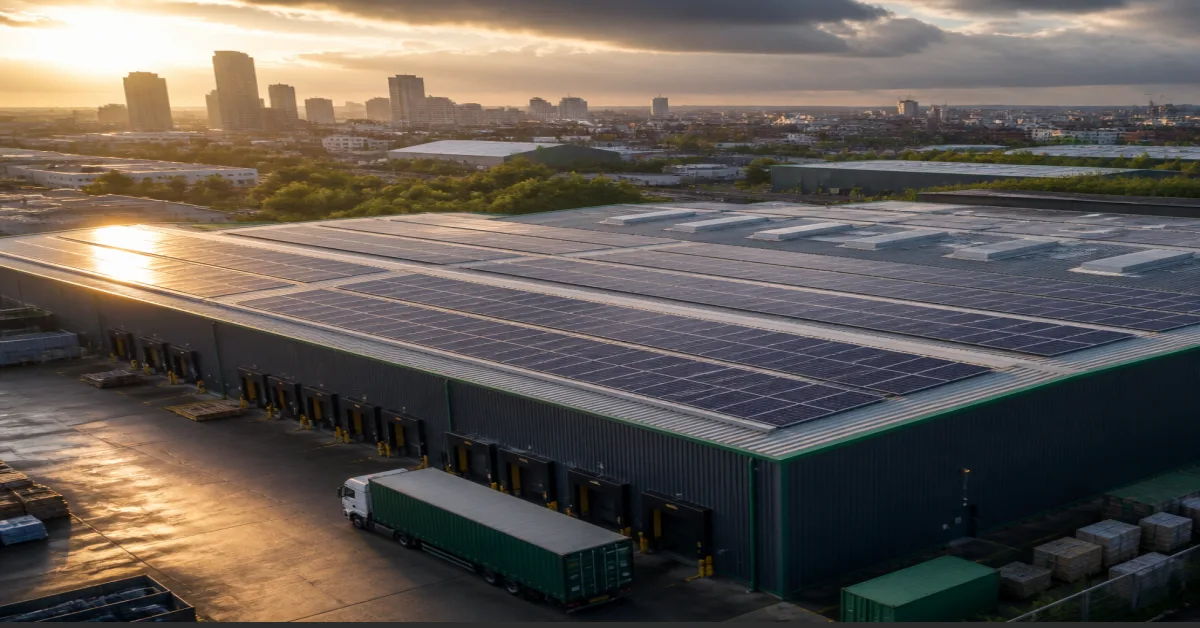
Warehouse roofs are the most underutilised commercial asset in the UK because large unobstructed surfaces coincide with high daytime electricity use. For a typical 250 kWp system with high self-consumption, this means illustrative annual savings of £58,000, an average payback of 3.8 years, an annual carbon offset of 78 tCO2e, and an 85% daytime demand offset.
Across Trafford Park, Openshaw, and the Oldham Road corridor, the load profile matches generation. Lighting, refrigeration, conveyor systems, and loading bays run during peak daylight hours. You consume what you produce, which means less export and more savings per unit. Manchester's climate is not the obstacle many assume. Overcast days still generate through diffuse light; Solar Energy UK confirms North West irradiance supports commercial viability with payback well under a decade. The question is not whether solar works here, but how much capacity and self-consumption your roof and shift pattern can deliver.
Large Clear Surfaces
Flat or low-pitch spans over 1,000 m² with steel portal frames and few obstructions.
Daytime Load Match
Lighting, conveyors and refrigeration run when generation peaks for maximum self-consumption.
Permitted Development
Most industrial warehouses proceed without full planning, verified per site.
Diffuse-Light Output
Overcast Manchester skies still generate, supporting payback well under a decade.
Typical warehouse construction strengthens the case: flat or low-pitch profiles, spans often exceeding 1,000 m², steel portal frames, and few obstructions compared with offices. Permitted development is the default advantage for most industrial warehouses, though it must be verified for each site. Bee Commercial Solar works on Manchester sites daily and can assess your roof's potential with a survey.
Call Bee Commercial Solar on 0161 570 0596 to arrange a survey and quote.
Whether Your Warehouse Roof Can Take Solar Panels
Not every roof is ready on day one; an MCS-accredited structural and electrical survey precedes any design. Most Greater Manchester roofs are profiled metal on steel portal frames, and a typical solar panel adds around 12–15 kg/m². Wind and snow loads are already designed in, but every roof is checked because assumptions get expensive. If you are considering a bespoke system, you can explore a detailed solar design service to understand how the process works after the initial assessment.
Here is the detailed roof survey checklist:
- Corrosion, damaged fixings, failed sealant, and overall roof age or condition; rusted bolts and degraded flashings are the first signs a roof may need attention before a solar array is added
- Structural load, using original steelwork drawings or a structural engineer's report; ballasted systems add ~10–15 kg/m² while penetrative mounts transfer load at specific fixing points
- Orientation and pitch; south is ideal, but east-west split arrays are common on wide Trafford Park roofs and can extend the generation window
- Shading from plant, parapets, and neighbouring buildings; even a small shadow on one string drags output down, so any shading analysis must be string-level, not just roof-level
- DNO connection, meter setup, and export headroom to confirm the grid can accept the system; this is checked early because a grid constraint can change the system size or add a battery to manage export
If asbestos cement sheets are present, HSE-licensed removal must happen before any disturbance. Work halts until then; the time and cost come upfront, which is safer and legal. The clearest reason not to install is a failing roof with roughly five years of life left. Panels on a roof that needs replacement is a double spend, the survey's job is to stop that mistake before procurement. A minor repair, like replacing corroded bolts on an Ardwick site, is different from a full re-roof gate; the survey report will tell you which category you are in.
Survey realism helps here: a typical visit takes 45 minutes, and a report is delivered within five business days. If you are a tenant, landlord consent and a pack with structural certificates and insurance confirmations are needed; these are practical documents, not a blocker, and Bee prepares them as part of the early process.
Book a survey to confirm your roof is in the go category.
How Solar Installation Works on a Manchester Warehouse
Survey to switch-on typically takes six to ten weeks, and the longest wait is usually DNO response, not install labour. The process follows a clear, numbered sequence:
Survey & Structure
Flat vs pitched mounting assessed, including access for lifting equipment.
System Design
Sized to half-hourly load data to avoid oversizing into dump export.
DNO G99
Application for systems above 16A per phase handled by Bee.
Permitted Development
Confirmed with the authority every time, including exceptions.
Installation
Typical 100 kWp in 5–8 working days around live operations.
Commissioning
String tests, voltage checks and monitoring handover.
- Site survey and structural check; flat vs pitched mounting is assessed on Trafford Park-type roofs, including access routes for lifting equipment
- System design matched to consumption data to avoid oversizing into dump export; half-hourly load data shapes the array size, not just roof area
- DNO G99 application for systems above 16A per phase; Bee handles the paperwork, and the timescale is weeks, not mystery months
- Permitted development confirmation with the local authority every time; conservation or listed exceptions are checked even when the site is a standard industrial unit
- Installation; a typical 100 kWp system takes five to eight working days, scheduled around live warehouse operations such as deliveries and shift handovers
- Commissioning, string tests, and monitoring handover; this includes verifying each string produces expected voltage before the system goes live
Install days are short, DNO response is the critical path, and Bee Commercial Solar plans disruption around distribution centre activity. MCS accreditation covers the survey and installation work. For more detail on how Bee manages each stage, you can review the commercial installation process used on projects like yours.
Call 0161 570 0596 for a free survey and a credible local delivery plan.
Rooftop vs Ground-Mount for Greater Manchester Distribution Sites
The choice depends on roof condition, yard space, and growth plans, not a universal rooftop is always best rule. Site access also matters: ground-mount systems are easier to service, but rooftop avoids sacrificing yard space. Industrial factory solar installations often use a mix of both approaches to balance cost, performance, and available space.
| Factor | Rooftop | Ground-Mount |
|---|---|---|
| Planning | Usually permitted development on existing industrial buildings | May require planning within industrial estates with design codes |
| Structure | Roof must support additional load; ballasted ~10–15 kg/m²; profiles must handle point loads from racking | Independent foundations; no load on the building |
| Land use | Zero yard loss; roof space is otherwise unused | ~1–1.5 acres per 250 kWp; land can still be used beneath for parking |
| Cost | ~£1,000–£1,300 per kWp | ~£1,250–£1,600 per kWp |
| Size potential | 50,000 sq ft supports roughly 250–350 kWp; ~1,800 m² usable for a 250 kWp class system | 2-acre yard supports 400–500 kWp |
| Performance | Fixed to roof pitch or flat tilt; output depends on orientation | Optimised tilt and airflow; panels run cooler, yielding 5–8% more per kWp |
| Maintenance | Requires safe roof access and working-at-height protocols; cleaning is less frequent but more complex | Ground-level access; cheaper and faster to service or clean |
| Best use case | Modern sound roofs with high daytime loads and limited yard space | Older roofs with degradation, large yards, or EV carport canopies |
Most large hubs benefit from a combined strategy: rooftop for immediate generation plus a ground-mount array or solar carport in the yard for additional capacity and EV integration. A survey assesses roof, yard, and DNO headroom to recommend the optimal split.
Connecting Solar, Battery Storage and Workplace EV Charging as One Design
Daytime roof generation does not cover evening refrigeration or overnight logistics; batteries shift surplus, and EV chargers should not default to expensive grid kWh. The combined architecture is roof PV to inverters to batteries to workplace EV charging, with energy management software balancing load across all three.
- One electrical design, one DNO application, one commissioning process; later add-ons mean a second application and added cost
- Commercial battery storage absorbs excess daytime generation for evening or overnight use, preventing exported kWh earning low rates while you buy grid power later
- Workplace EV charging draws from stored solar first, grid second; this keeps fleet charging costs down as electrification scales
- Energy audit before equipment is ordered to size the system correctly; the audit reviews half-hourly loads, shift patterns, and any foreseeable fleet expansion
On Trafford Park-type sites with round-the-clock demand, batteries can outperform solar alone. Designing battery and EV later as add-ons often means a second DNO process and higher cost; specify them in the first application when fleet or night load is foreseeable. This is particularly critical for sites with continuous operation; a case study from a similar round-the-clock site demonstrates the value of this integrated strategy. For specialist guidance on high-availability facilities, see how solar for data centres addresses similar constant-load challenges. A combined system also strengthens tender and supply-chain carbon reporting, a commercial advantage for winning contracts because it attaches a verified saving per tonne of CO2 rather than a vague sustainability claim.
Arrange an energy audit before any equipment is ordered.
Monitoring and Protecting the Warehouse Solar Asset
Unnoticed underperformance costs real money, so live data on generation, building consumption, and export is essential after commissioning. Solar performance monitoring is the first line of defence against these issues. Most problems with warehouse solar do not announce themselves; panels keep working, just not as well as they should.
Monitoring catches these silent faults:
- Dirt buildup, bird mess, or micro-cracks reducing individual panel output; bird mess is common near warehouse eaves where pigeons perch
- Inverter faults that silently reduce total output or stop one string entirely
- Consumption spikes inside the warehouse that eat into savings, such as a new chiller or an equipment fault running overnight
- Grid export issues affecting tariff income, including meter communication faults or export limiting being applied incorrectly
One client near Trafford Park produced 15% below expected output for six weeks before a routine check found two loose string connections. A 30-minute fix recovered full generation. Without monitoring, that fault could have run quietly for a year. String-level monitoring would have flagged the drop within hours, not weeks.
A performance record also supports refinance, property sale, or additional financing; lenders accept verified generation data as evidence of asset value. Surplus can be sold under the Smart Export Guarantee where relevant. Bee's in-house maintenance team turns monitoring alerts into scheduled fixes, so the roof remains a revenue-generating Manchester asset.
Call to discuss monitoring for your site.
Solar Readiness and How to Enquire
The next step is a no-obligation survey that sizes the system to half-hourly data, not a simplified web calculator alone. Use this compact checklist to see where you stand:
Large unobstructed roof; a 250 kWp class system needs ~1,800 m² usable
High daytime bill or load; refrigeration, conveyors, and loading bays during daylight hours strengthen the business case
Roof age and structure; 92% of roofs Bee assesses require zero structural work, based on surveyed stock rather than industry averages
Owner or landlord consent; landlord packs include structural certs and insurance, which Bee prepares early
Daylight operations for maximum self-consumption; a night-only operation has a weaker case for rooftop solar alone
Battery or weekend export consideration under SEG; a battery can shift weekend surplus into weekday early shifts
A calculator gives illustrative UK averages, but a proper proposal uses half-hourly data, shading analysis, and structural assessment. Even a mixed readiness picture can work if yard space or DNO headroom is strong; only a survey settles it. Bee's relevant sector capability includes a 250 kWp Mersey Logistics array in Liverpool with 85% daytime offset and £58k annual savings, plus a Sheffield O&M recovery that restored a 350 kWp system to 98% of design output; these are outside Manchester but demonstrate the delivery model Bee brings to local sites.
Related services include commercial solar installation, battery storage for warehouses, workplace EV charging, solar monitoring, roof structural surveys, and G99 applications.
Get a free quote or book a free site survey by calling 0161 570 0596. Bee Commercial Solar serves Manchester sites directly.
Frequently Asked Questions
Frequently Asked Questions
Do Manchester warehouses need planning permission for solar panels?
Most warehouse solar installations in Manchester fall under permitted development rights, so full planning permission is usually not needed. We confirm this with the local authority on every project because buildings in conservation areas or with listed status have different rules.
What happens if my warehouse roof has asbestos sheets?
Work cannot start until the asbestos is professionally removed. The Health and Safety Executive requires licensed removal before any installation that disturbs asbestos materials. We flag this during the roof survey, not after panels are ordered.
How long does a commercial solar installation take on a Manchester warehouse?
A typical 100 kWp system takes five to eight working days to install. The DNO application for systems above 16A per phase can take a few weeks beforehand. The full process from survey to switch-on takes six to ten weeks, and we handle the DNO paperwork for you.
Will solar panels actually work in Manchester's cloudy climate?
Yes, panels generate power year-round, even on overcast days, because diffuse light still produces electricity. Solar Energy UK confirms the North West receives enough annual solar irradiance to make commercial installations financially viable.
What does the roof survey actually check before installation?
The survey checks roof age, condition, corrosion, structural load capacity, orientation, shading from nearby buildings or rooftop plant, and existing electrical infrastructure. We review original steelwork drawings or bring in a structural engineer if needed. The DNO connection is also reviewed to confirm export headroom.
Can solar panels be fitted on an east-west facing warehouse roof?
Yes, east-west split arrays work well on wide warehouse roofs and are common across Manchester sites. South-facing is ideal, but an east-west layout spreads generation across more of the day, which can match your energy demand profile better.
Ready to Explore Solar for Your Warehouse?
We will survey your site, model your savings, and present a tailored proposal — no obligation, no pushy sales calls.
Typical survey takes 45 minutes. Report delivered within 5 business days.