
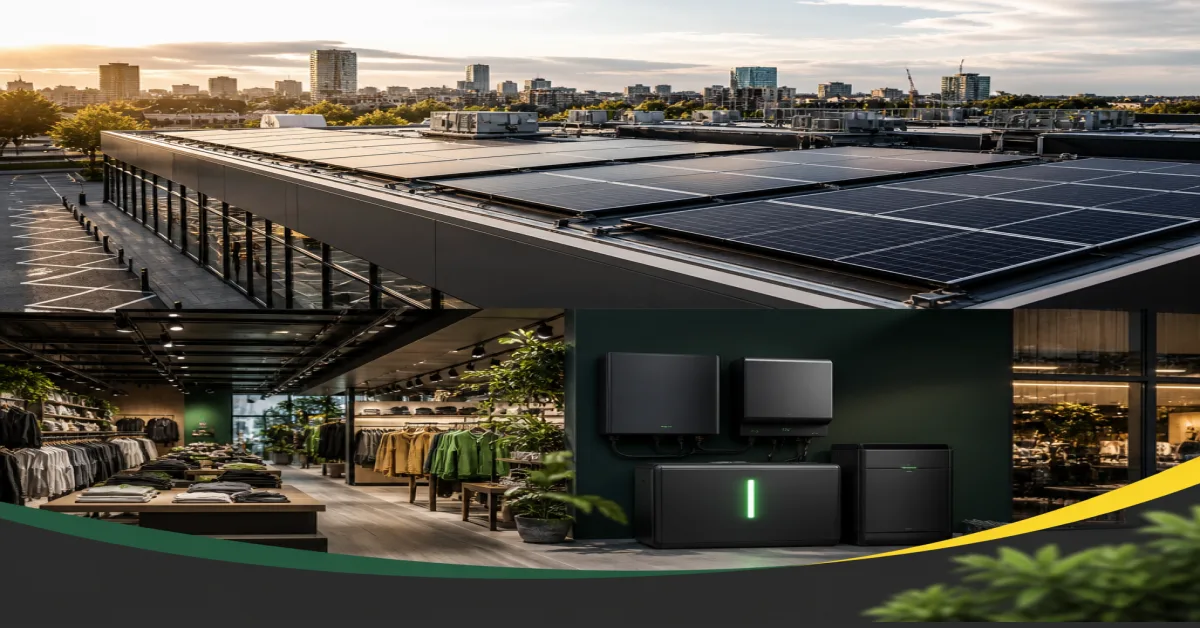
Retail Solar Panels Manchester | Bee Solar
Cut retail energy bills 30–50%. Rooftop plus carport canopies, zero trading disruption.
70-85%
Typical on-site self-consumption
50-100 kW
Typical 10,000 sq ft roof capacity
3-5 days
Typical install with store open
30-50%
Retail bill reduction potential
What's Covered on This Page
- Why Retail Stores in Greater Manchester Are Strong Solar Candidates
- How Manchester’s Climate Affects Solar Output for Retail Roofs
- Ballasted Mounting on Flat Retail Roofs
- Zero-Downtime Installation Process for Trading Stores
- Matching Generation to Your Store’s Load Profile
- Planning, Permitted Development, Landlord Consent and DNO in Manchester
- Enquire for a Manchester Retail Site Survey
- Frequently Asked Questions
Why Retail Stores in Greater Manchester Are Strong Solar Candidates
Retail stores in Greater Manchester are strong solar candidates because their peak energy demand overlaps with solar generation, allowing most of the power produced to be used on-site rather than exported. For a typical retail store, this on-site usage, or self-consumption, reaches 70-85%, a figure that makes the financial case considerably stronger than for buildings that empty at 5pm. We provide commercial solar installation and energy consulting for retail premises across Manchester, including typical flat-roof units in Ancoats and Trafford Park. This capability extends across sectors, from solar solutions for Manchester hotels to solar projects for large venues, but our retail systems are tailored specifically to your needs.
Your store's load profile is the reason for this high self-consumption rate. Unlike an office that powers down in the evening, a shop draws electricity throughout trading hours:
- Lighting across the shop floor from open to close
- Refrigeration and HVAC units running constantly during trading
- EPOS systems, security cameras, and signage drawing power
- Customer-area heating and cooling regardless of footfall
Daytime Trading Match
Lighting, HVAC and EPOS draw power when generation peaks for 70-85% self-use.
Large Flat Roofs
~10,000 sq ft supports 50-100 kW with unobstructed layouts.
Constant Baseload
Refrigeration and cooling provide steady demand even between footfall peaks.
Load-Matched Sizing
Sized to trading load, not just roof area, to avoid weak export returns.
Most Manchester retail buildings have large, unobstructed flat roofs. A ~10,000 sq ft roof can often support a 50-100 kW system, subject to survey. This self-consumption ratio matters more than panel count; oversizing for cheap export is a weaker commercial outcome than a well-matched daytime retail system. Retail is a fast-growing segment for commercial rooftop solar, with UK commercial rooftop installations growing across the country in 2023 according to Solar Energy UK. A system designed around your daytime trading load delivers a stronger return than one sized purely for roof area. Book a load-profile analysis to see your store's specific savings potential.
How Manchester’s Climate Affects Solar Output for Retail Roofs
Manchester receives around 1,100-1,200 sunshine hours a year, and modern panels respond to daylight, not just direct sunlight, so overcast days still produce usable energy. Cloud cover is usually not the main retail constraint in Manchester; unmatched roof geometry, shading, and unmodelled winter and summer load shapes are. The Solar Energy UK trade body confirms the North West is a commercially viable region for solar installations.
On a site survey, we factor in:
- Annual irradiance levels specific to the building's postcode
- Seasonal shading from nearby structures or trees
- Roof condition and load-bearing capacity
- Trading hours and when electricity demand peaks
- Winter versus summer consumption patterns, including cooling loads
South-facing flat retail roofs, common on city-centre units near Piccadilly, provide flexibility to angle panels for maximum yield. Winter generation dips between November and February, but this is modelled in the design and balanced against your higher summer demand. Summer generation often peaks when cooling loads and footfall are highest, which aligns with your highest bills. The design accounts for these seasonal shifts so the system is sized for what you use, not just what the roof can hold.
Ballasted Mounting on Flat Retail Roofs
Weighted frames protect the membrane with no drilling. For a project case study that demonstrates how this works on a retail site, you can see a solar canopy on a Leeds retail park, which shows how roof-space challenges were overcome for a retail scenario.
| Factor | Ballasted Mounting | Penetrative Mounting |
|---|---|---|
| Tilt | 15-35 degrees optimised for UK sunlight | Fixed to roof pitch, less flexible on flat roofs |
| Roof impact | Weighted, no membrane cuts or drilling in most cases | Requires fixings through membrane with sealing |
| Cabling | Routed to inverter and meter with no major building work | May need additional roof penetrations for routes |
| Best use case | Large low-pitch Ancoats and Trafford Park retail roofs | Pitched or structurally constrained roofs |
- Tilt: Frames are angled at 15-35 degrees to optimise generation for UK sunlight.
- Weights: The frames are held in place by ballast, not penetrations, distributing load across the roof surface.
- Cabling: Cables are routed to the inverter and meter with no major building work.
- Survey check: A structural survey still confirms load-bearing capacity and membrane condition before any equipment is specified.
To determine the best technology for your specific setup, it's worth reviewing your commercial solar panel choices to understand how different modules perform under ballasted mounting. This is critical because the ballast calculation accounts for wind uplift and the specific roof construction, so the system remains secure without compromising the waterproofing layer. This approach is particularly well suited to the large, low-pitch roofs common on Manchester retail units where membrane quality is critical to the building.
Zero-Downtime Installation Process for Trading Stores
Your store stays open throughout the installation, and we schedule roof work around your trading hours. Customers are often unaware work is taking place overhead. We plan deliveries and roof access to avoid peak footfall times, keeping the shop floor completely operational.
Site Survey & Energy Audit
Roof, shading, load capacity and bills reviewed to shape the design.
System Design
Layout with month-by-month output and savings modelled upfront.
DNO & Planning Checks
Grid application and permitted development confirmed for you.
Installation
Three to five days around trading hours with shop floor open.
Commissioning & Monitoring
Full testing plus remote generation tracking configured.
Handover & Support
Documentation, operation walkthrough and maintenance aftercare.
- Site survey and energy audit: We assess roof condition, orientation, load capacity, shading, and review your energy bills and consumption patterns.
- System design: Our engineers create a layout and model expected output month by month, so you see projected savings before any orders.
- DNO application and planning checks: We handle the Distribution Network Operator application and confirm grid connection requirements.
- Installation: A typical installation takes three to five days, scheduled around trading hours with the shop floor remaining open.
- Commissioning and monitoring: We test the full system and configure remote monitoring for real-time generation tracking.
- Handover and support: We provide full documentation and explain system operation, with maintenance available as aftercare.
The quality of the initial survey and load-aware design, not the number of panels, is what keeps ROI consistent. Trading-hours scheduling is a retail-specific delivery constraint we plan for on every Manchester project. A rushed survey leads to undersized systems or shading issues that surface months later. We invest in the audit stage because it protects your return for the life of the system.
Matching Generation to Your Store’s Load Profile
We start with an energy audit of half-hourly data, seasonal trading, and unusual spikes, because an "almost perfect" overlap is not enough for a significant investment. System sizing is designed to your specific demand, not a generic kW figure or a calculator estimate. Copying a neighbour's system size is a common and costly mistake.
Key data points we use include:
- Your baseload, the minimum electricity drawn even when quiet
- Peak demand windows and whether they shift between seasons
- Large single loads like commercial refrigeration or air conditioning
- Weekend versus weekday consumption differences
- Half-hourly export potential and tariff structure
A convenience store with 24-hour cold cabinets has a very different load shape than a fashion retailer open for ten hours, and the array size and design must reflect this. For a convenience store, the refrigeration baseload means the system can run at high utilisation even outside opening hours. For a fashion retailer, the array is sized to match the shorter trading window, avoiding unnecessary export. Self-consumption of 70-85% is more important than raw panel count; an oversized array that exports excess power at low tariffs is a weaker investment. If your store trades into the evening, we assess whether solar battery storage can shift daytime generation to later hours, but this is not a default upsell for every site.
Any simplified ROI calculator is an estimate only; an accurate proposal requires the survey, shading analysis, structural check, and half-hourly data. We provide a detailed proposal with month-by-month generation and savings projections based on your actual consumption, not industry averages.
Planning, Permitted Development, Landlord Consent and DNO in Manchester
Most flat-roof commercial retail installations in Manchester fall under Permitted Development, so full planning permission is often not required, but conditions apply. Misinterpreting these conditions can cause delays. Understanding the specific criteria for your roof type is essential before committing to a timeline.
- Permitted development criteria: Panels must not protrude more than 200mm from the roof surface and cannot sit higher than the highest point of the roof. Flat-roof edge setbacks apply.
- Listed or conservation areas: Units around Deansgate or the Northern Quarter may require consent from Manchester City Council.
- Landlord and freeholder approval: If leased, written consent from your landlord is required. This often causes more delays than planning; start early. We can provide technical drawings and structural calculations to support your application.
- DNO notification: A G99 grid notification is mandatory, and we handle the application. For a deeper understanding of this process, see our guide to G99 grid applications. This secures permission to connect the system to the grid and can take several weeks depending on the local network.
Landlord and lease timing, not the roof crew, is usually the critical path. We can supply technical packs for your landlord to facilitate their decision. For leased units in retail parks such as those in Gorton or Harpurhey, the landlord's structural team may require additional documentation, which we prepare as standard. If a planning application is required, we manage the submission entirely, including any required heritage statements for conservation areas.
Enquire for a Manchester Retail Site Survey
Bee Solar provides end-to-end commercial solar for Greater Manchester retailers: survey, design, DNO, installation around trading, monitoring, and aftercare. A typical survey takes around 45 minutes, and we deliver the report within 5 business days. We will not provide an exact payback figure without a load-profile analysis, because an accurate number depends on your specific consumption patterns and roof characteristics.
45-minute survey with report in 5 business days
Half-hourly bills and roof access notes ready
Installation scheduled around trading hours
Monitoring, maintenance and financing options included
To make the enquiry productive, have your half-hourly energy bills and roof access notes ready. This includes information about roof access points, any existing equipment on the roof, and your lease terms if you are a tenant. Online calculators without that data are not a substitute for a proposal. Call 0161 570 0596 or Get a Free Quote to start. We also provide commercial solar installations, energy consulting and load profile analysis, solar battery storage, solar panel maintenance, and solar financing options to help manage upfront costs.
Frequently Asked Questions
Frequently Asked Questions
Do solar panels actually work well on Manchester retail stores given the cloudy weather?
Yes, solar panels work well on Manchester retail stores. Modern panels respond to daylight, not just direct sunshine, and Manchester receives around 1,100 to 1,200 hours of sunlight per year. Your store's peak energy use, from lighting and HVAC to refrigeration, lines up with daylight hours, meaning you use most of the power you generate on-site, typically 70-85%.
Will you need to close my store during the solar installation?
No, your store stays open throughout the installation. We schedule all roof work around your trading hours, and most customers never notice our team is on the roof. For most flat-roof retail units in Manchester, the process causes no disruption to your shop floor, staff, or customers.
Do Manchester retail stores need planning permission for rooftop solar panels?
Most retail stores do not need full planning permission. Flat-roof commercial installations typically fall under Permitted Development rights, provided conditions on protrusion (200mm), height, and edge setbacks are met. If your building is listed or in a conservation area, additional consent may be required, which we flag during the survey.
How much of the solar energy my store generates will I actually use on-site?
Retail stores typically self-consume between 70 and 85 percent of their solar generation. This is higher than offices or warehouses because your lights, refrigeration, EPOS systems, and HVAC run during daylight hours. This direct use replaces grid electricity, which is worth more than exporting surplus at a lower tariff.
What size solar system can fit on a typical Manchester retail roof?
A 10,000 square foot flat retail roof can usually support a system between 50 and 100kW. The exact size depends on roof condition, orientation, shading, and your actual electricity demand. We determine the size through a full site survey and energy audit, not a generic estimate.
What happens during the site survey before installation starts?
During the site survey, we assess roof condition, load-bearing capacity, orientation, and shading from nearby structures. We also review your energy bills to understand consumption patterns. This data shapes the system design and is the strongest predictor of long-term performance.
Is there a “best solar panel” for a shop, or should I buy direct from a manufacturer?
The best system for a shop is not determined by a single panel brand. Suitability depends on your flat roof structure, ballasted mounting design, and matching generation to your store's specific load profile. Buying direct from a manufacturer bypasses the critical steps of site survey, DNO application, and installation planning, which is where project success is determined.
Do I need batteries if my store trades into the evening?
Batteries are only justified if evening trading lifts your self-consumption significantly. We assess your half-hourly load data to see if surplus daytime generation can be shifted to evening peak tariff periods. Not every site requires storage, and we advise on this transparently during the design phase.
Ready to Cut Your Retail Energy Bills?
We will survey your store, model savings around trading hours, and present a tailored proposal — no obligation, zero downtime.
Typical survey takes 45 minutes. Report delivered within 5 business days.