
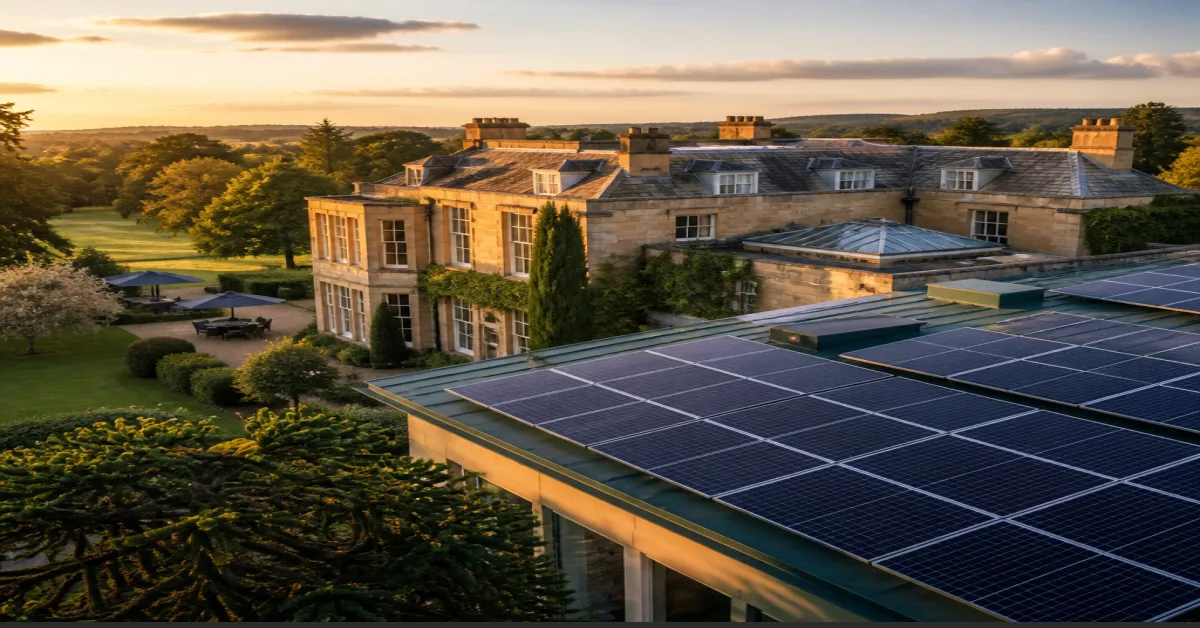
Boutique Hotel Solar Installation Cheltenham | Bee Solar UK
Case study: 150 kWp boutique hotel solar project in Cheltenham. Reduced annual costs by £41k for a Grade II listed property. See the results.
Client
Cotswold Country House Hotel
Location
Cheltenham, Gloucestershire
System Size
150 kWp Rooftop PV
Completed
2023
This is a PV case study, not a hotel named “Solar”
This page documents Bee Solar's 150 kWp rooftop PV installation at Cotswold Country House Hotel, Cheltenham, Gloucestershire, completed in 2023. It is not a boutique-hotel directory and not a property named "Solar." Bee Solar, a Manchester and Greater Manchester installer (phone 0161 570 0596), delivered this heritage hotel project in the Cotswolds.
This proof is for hotel owners and estate managers of heritage or boutique properties who need lower operational electricity costs without compromising listed character. It supports Bee Solar's Commercial Solar Installation service.
- This project is: A 150 kWp heritage hotel PV installation on a Grade II listed property.
- This project is not: A hotel directory listing or a property named "Solar".
- Provider: Bee Solar, Manchester-based installer. Next step: free site survey or 0161 570 0596.
The Grade II constraint: high hotel load, zero public visual impact
Cotswold Country House Hotel is Grade II listed; solar panels could not be visible from the main approach or public footpaths. The energy problem here was operational cost, not a generic "going green" exercise: high electricity demand from heating, cooling, and kitchen operations made PV financially attractive if the aesthetics could be resolved. This project is a clear proof point for our commercial hotel solar services, demonstrating that heritage constraints don't have to rule out significant savings.
Solar is not automatically easy on every listed building. The decision is not "can we buy panels?" but "can any roof plane be hidden from public view while still serving daytime hotel load?" Hospitality electricity demand is heavily weighted to daytime hours—kitchen prep, laundry, guest services, and HVAC—which is exactly when solar generation peaks.
Key Constraints
- Planning refusal risk for visible roof panels.
- Guest-facing ugly kit damaging first impressions.
- Disruption to an occupied, trading hotel.
- "Is this only for warehouses?" doubt from the buyer.
How planning and aesthetics were resolved on the rear stable block
Bee Solar worked with conservation officers to place the entire 150 kWp array on a rear stable-block roof invisible from public areas. The aesthetic specification used all-black monocrystalline panels on a dark mounting frame to minimise visual intrusion. The system design offsets 70% of the hotel's daytime load. This careful approach is a prime example of navigating commercial solar regulations to a successful outcome.
Planning caveat: listed consent is site-specific. If the only viable roof is highly visible from the principal elevation, expect a harder planning path. Bee Solar does not promise approval in that scenario. Works on the occupied hotel were planned to protect guest experience; specific method statements and programmes are confirmed at survey.
Hidden siting
Entire 150 kWp array on rear stable-block roof invisible from main approach and public footpaths.
Discreet specification
All-black monocrystalline panels on dark mounting frame to minimise visual intrusion.
Conservation liaison
Engagement with conservation officers testing public views, favouring planning success over maximum yield.
This siting strategy differs from principal-elevation or approach-visible arrays. A hidden rear or outbuilding roof favours guest first impression and planning success; a highly visible roof favours yield but risks refusal and aesthetic harm. Gallery captions for this project restate the rear-stable-block siting and all-black discretion, not empty eco language.
Project results: £41,000 a year, 4.5-year payback, guest scores
Annual electricity costs were reduced by £41,000 on this 2023 project. Attributed only to this installation: 70% daytime load offset, a 4.5-year payback period with full expensing tax relief, guest satisfaction scores for sustainability increasing by 18%, marketing value from "solar-powered hotel" messaging, and no visual impact on listed-building aesthetics. For those interested in the financial side, it's worth exploring solar financing options to see how you could structure a similar investment.
Annual electricity cost reduction: £41,000
Daytime load offset: 70%
Payback period: 4.5 years with full expensing tax relief
Guest satisfaction scores for sustainability: +18%
Visual impact on listed-building aesthetics: none
| Metric | Result |
|---|---|
| Annual electricity cost reduction | £41,000 |
| Daytime load offset | 70% |
| Payback period | 4.5 years with full expensing tax relief |
| Guest sustainability scores | +18% |
| Visual impact | None |
Full expensing was used in this project's payback presentation. This is a capital allowance that lets qualifying businesses deduct the full cost of eligible plant and machinery from taxable profits in the year of purchase. Confirm your own tax position with an accountant; these figures are not guaranteed for other hotels.
Who this Cheltenham proof is for—and who should be cautious
Bee Solar surveys from Manchester for comparable heritage, boutique, and commercial sites in the wider region. Related commercial practice, delivered under the same discipline: Mersey Logistics 250 kWp warehouse array in Liverpool; the Yorkshire Retail Park carport solar project; and similar work at Park Lane Primary Academy. This Cheltenham hotel remains the hero project for heritage proof—it demonstrates that 150 kWp of generation is achievable without a warehouse roof if a concealable plane exists.
Good fit
- Property has high daytime electrical load from kitchen, laundry and HVAC.
- Roof or outbuilding such as rear stable block that can be kept out of public view.
- Willingness to work with conservation officers on design and materials.
Not a fit
- Only viable roofs are street-facing or on the principal elevation.
- Expectation of automatic listed consent without site-specific assessment.
- Treating solar as easy on all listed buildings.
From free site survey to occupied-hotel install
Every project starts with a free site survey. Bee Solar is a sensible choice for this location: evidenced Grade II Cheltenham hotel delivery from a Manchester base, not generic "commercial solar" claims.
Visibility mapping and load review
Assess public views, roof planes and daytime hotel load profile.
Conservation and planning liaison
Work with officers to secure site-specific consent with discreet detailing.
Occupied-hotel install
Install on an occupied hotel with disruption and access covered at survey.
Aftercare and monitoring
Including post-installation monitoring services and maintaining your solar system's performance.
The survey will cover access, phasing, and guest-facing constraints. The first commercial step is a view-and-load survey with planners in mind, not shopping for the highest kWp.
Start your project with a free site survey: 0161 570 0596.
Frequently Asked Questions
Can a Grade II listed boutique hotel get solar panels?
Yes, subject to site-specific listed consent. This Cheltenham hotel received 150 kWp of solar by siting the array on a rear stable-block roof invisible from public areas and working with conservation officers. Approval is not automatic; each listed building is assessed on visibility and design impact.
Were the 150 kWp panels visible from the hotel approach or public footpaths?
No. The entire array was placed on the rear stable-block roof, so no panels were visible from the main approach or public footpaths. All-black monocrystalline panels on a dark mounting frame further reduced visual intrusion.
What annual saving and payback did Cotswold Country House Hotel achieve?
Annual electricity costs were reduced by £41,000. The payback period was 4.5 years with full expensing tax relief, and the system offset 70% of the hotel's daytime load. These figures are specific to this 2023 project, not a guarantee for other sites.
What is full expensing in this hotel solar project's payback—and is it advice for every owner?
Full expensing is a tax relief that was applied in this project's payback calculation. It allowed the hotel to deduct the qualifying expenditure from taxable profits in the year of purchase, contributing to the 4.5-year payback. Tax law can change and depends on individual circumstances, so confirm your position with an accountant.
Will an occupied hotel have to close during installation?
This project was delivered on an occupied hotel with works planned to protect guest experience. Specific access, phasing, and disruption arrangements are confirmed during the free site survey. There is no universal answer without surveying the property.
Is solar straightforward on every listed building?
No. Solar is not easy on every listed building. Success depends on finding a roof plane or outbuilding that can be kept out of public view, engaging with conservation officers, and accepting that consent is site-specific. If the only viable roof is highly visible from the principal elevation, expect a harder planning path.
How do I book a free site survey with Bee Solar from Manchester?
Call Bee Solar on 0161 570 0596 to book a free site survey. Bee Solar surveys from Manchester for comparable heritage, boutique, and commercial sites in the wider region. The survey covers visibility mapping, load review, access, phasing, and guest-facing constraints.
Want Results Like This?
Every project starts with a free site survey. Let us show you what solar can do for your building.