
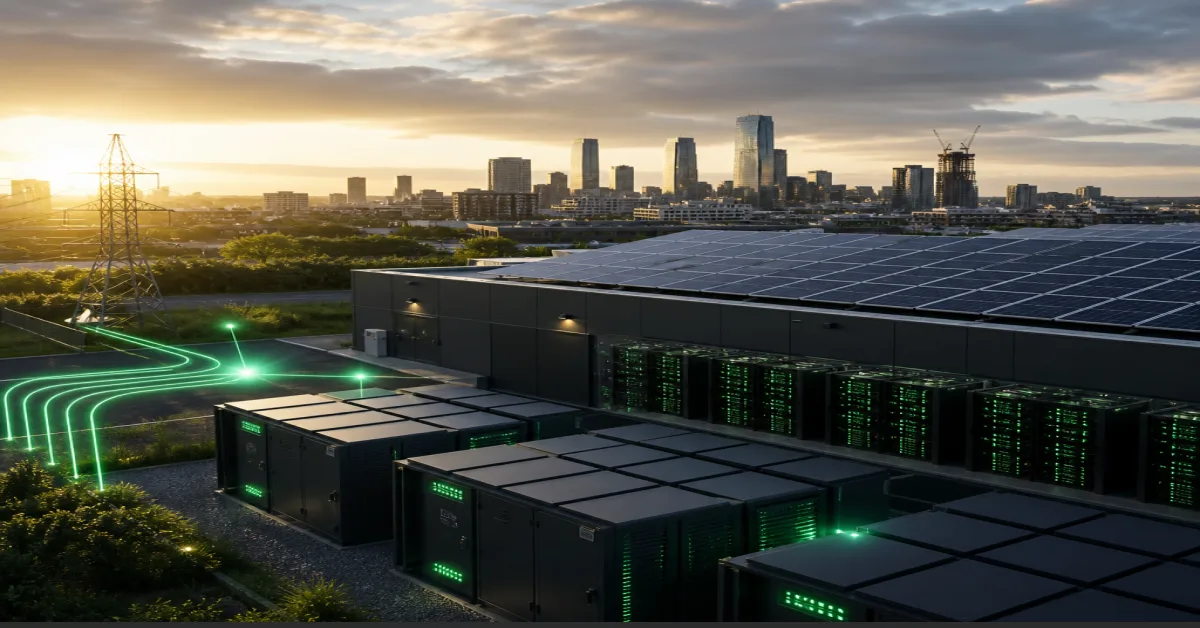
Data Centre Solar & Battery Storage UK
1 MWp + 1 MWh BESS reference site. Cut baseload cost and add backup resilience.
£156k/yr
Annual savings (1 MWp + 1 MWh)
5.1 yr
Average payback with storage
312 tCO2e
Annual carbon offset
98.5%
Uptime-protection improvement
What's Covered on This Page
- On-Site Solar + BESS That Extends UPS Time, Cuts Peak Cost, and Improves PUE
- Why Data Centres in Greater Manchester Are a Strong Fit for Parallel PV
- UPS Bridge Extension: 10 Minutes vs 45–60 Minutes
- LFP vs NMC Battery Chemistry for Halls and Fire Policy
- Crowded Roofs: LiDAR, Elevated Frames, and 70% Area Recovery
- Mission-Critical Power Quality: Parallel Operation Without SLA Risk
- How On-Site Solar Improves Published PUE and Auditable Scope 2
- Frequently Asked Questions
Need Solar for Data Centres?
0161 570 0596
Get A Free Quote. Bee Commercial Solar is ready to help.
On-Site Solar + BESS That Extends UPS Time, Cuts Peak Cost, and Improves PUE
Bee Solar designs behind-the-meter solar PV plus battery energy storage systems (BESS) for live data centres in Manchester and Greater Manchester as a resilience enhancer, not a diesel-generator replacement and not 24/7 islanding as default. A typical 1 MWp + 1 MWh system delivers £156,000 in annual savings, a 5.1-year average payback with storage, and 312 tCO2e of annual carbon offset, with a 98.5% uptime-protection improvement.
This profile requires approximately 8,000 m² of usable roof or ground area and generates around 850,000 kWh per year. The system operates in parallel with the grid: night and base load still import from the UK grid, while solar displaces daytime import in real time. The BESS shifts surplus generation to match the facility's peak demand window, which typically falls between 16:00 and 19:00 when grid import costs are highest.
UPS Bridge Extension
Extends critical backup from 10 minutes to 45–60 minutes while generators spool.
Peak Shaving 16:00–19:00
BESS shifts surplus solar into the highest-cost peak demand window.
PUE Improvement
850,000 kWh/year displaces grid import and improves published PUE.
Cooling Correlation
Cooling peaks in sunniest hours, aligning generation with thermal load.
Cooling load peaks in the hottest, sunniest hours, creating a generation-thermal correlation that offices and retail do not have. To assess your site, book a free site survey on 0161 570 0596.
Why Data Centres in Greater Manchester Are a Strong Fit for Parallel PV
On-site generation displaces grid import in real time and can improve published PUE; a PPA does not change the on-site PUE numerator or UPS bridge time. For data centres, peak demand charges typically represent 30-40% of the electricity bill, making BESS for afternoon peak shaving and self-consumption a direct cost lever that procurement contracts cannot replicate.
Across Manchester and Greater Manchester, our surveys cover commercial parks such as Trafford Park, plant-dense roofs in Salford Quays, carports, and ground-mount logistics on the outskirts. A 1 MWp / 1 MWh system at Thames Valley Data Centre Ltd in Slough achieved a 13% bill reduction (£156,000), a 42% peak demand cut, and extended bridge time from 10 minutes to over 60 minutes. You can explore the full details in our Slough data centre case study. In Stockport, a manufacturing facility (not a data centre) reduced energy costs by £102,000. For more examples, you can browse our broader library of commercial solar case studies.
AI and load growth increase both IT and cooling demand, which strengthens the case for on-site generation that correlates with cooling peaks. The remaining night and base load stays on the grid; this system does not imply 100% solar runtime.
UPS Bridge Extension: 10 Minutes vs 45–60 Minutes
Solar plus BESS extends critical-load backup from a typical 10 minutes to 45-60 minutes while generators spool; it does not replace UPS or diesel. The system feeds in parallel, with seamless islanding inverters switching in under 20 milliseconds, faster than a typical UPS transfer.
10 Minutes Standard
Typical UPS-only bridge leaves minimal margin if generators hesitate to start.
45–60 Minutes Bridged
Battery bridge cuts generator-start failure risk by 85% with prime standby.
During a grid outage, the battery discharges to critical loads while generators remain prime standby. This battery bridge extension reduces generator-start failure risk by 85%.
The energy management system partitions the battery so the cycling portion handles daily peak shaving while a reserve portion stays locked at 100% state of charge, ensuring daily cycling does not eat into UPS reserve. This partitioning is hard-coded at the EMS level, so operational staff cannot accidentally draw down the reserved capacity during routine cycling.
LFP vs NMC Battery Chemistry for Halls and Fire Policy
Bee Solar specifies LFP exclusively for indoor or adjacent data-centre installs; LFP thermal runaway occurs above 270°C versus around 150°C for NMC. This was a key consideration for us when we delivered a similar solar-plus-storage deployment for an NHS hospital.
| Property | LFP (Specified) | NMC (Avoid Near Halls) |
|---|---|---|
| Thermal runaway onset | >270°C | ~150°C |
| Indoor / adjacent data-centre policy | Accepted with fire-rated separation | Common specification error |
| Cycle life | 6,000+ cycles at 80% DoD, 15+ years | Typically lower cycle life |
Systems include multi-layer BMS, NFPA 855-compliant suppression, thermal runaway detection, off-gas venting, IP-rated enclosures, and fire-rated separation from server halls. Specifying NMC near halls is a common specification error even when lithium is allowed elsewhere in the facility.
Crowded Roofs: LiDAR, Elevated Frames, and 70% Area Recovery
Drone-mounted LiDAR and 3D CAD recover an average of about 70% usable data-centre roof area after plant survey. On one 1.2 MWp project, 75% of an apparently fully occupied roof was recovered by elevating arrays above cooling plant using raised mounting frames that allow airflow underneath. The recovered space can also support integrating EV charging infrastructure for on-site fleets.
Alternatives include elevated mounting, adjacent ground-mount, and carports. An indicative 8,000 m² supports a 1 MWp system, but structural and shading constraints still require a site survey. If structure, fire policy, or space still fail after LiDAR, the project does not proceed.
Treating the roof as unusable without a LiDAR/CAD survey is the first false "no." Chiller banks and ducting often leave usable gaps that ground-level visual inspection cannot identify.
Mission-Critical Power Quality: Parallel Operation Without SLA Risk
Sub-20ms islanding
Parallel operation never breaks the circuit; islanding is faster than UPS transfer.
Harmonic distortion < 3% THD
Active filters stay below 5% IEEE 519 / EN 50160 limit for server PSUs.
Voltage regulation ±1%
Smart inverters hold ±1% at point of common coupling.
Redundant architecture
N+1 or N+2 inverters allow hot-swap expansion without downtime.
- Sub-20ms islanding: The system operates in parallel with the grid and never breaks the circuit; islanding occurs in under 20 milliseconds, faster than a standard UPS transfer.
- Harmonic distortion < 3% THD: Active harmonic filters keep THD below the 5% IEEE 519 / EN 50160 limit, protecting server-grade PSUs from excess heating and premature failure.
- Voltage regulation ±1%: Smart inverters adjust reactive power to maintain ±1% at the point of common coupling, preventing sags and swells from affecting downstream equipment.
- Redundant architecture: N+1 or N+2 inverters allow hot-swap expansion without planned downtime; modular cabinets connect on live busbars during growth.
Across 300+ commercial installations, we have recorded zero power quality events attributable to solar or battery integration, and zero SLA breaches in that commercial set. Regular maintenance is key to protecting inverter efficiency and uptime.
How On-Site Solar Improves Published PUE and Auditable Scope 2
PUE equals total facility energy divided by IT energy; on-site renewable kWh is typically subtracted from the numerator per The Green Grid. A 1 MWp system generating 850,000 kWh/year improves PUE by 0.05-0.12 depending on baseline. This improvement is visible in the published annual PUE figure, not just internal operational metrics.
- Half-hourly, time-stamped generation data is exportable in GHG Protocol-compliant format for Scope 2, CDP, and hyperscaler audits.
- Optional EMS uses the Carbon Intensity API to discharge when grid carbon is high and charge when low, improving market-based Scope 2 reporting.
- DC-coupled cooling loops run compressors directly from PV at peak sun and peak cooling, reducing conversion losses versus AC-coupled alternatives.
Off-site PPAs and 100% renewable claims do not reduce the on-site PUE numerator or extend UPS bridge time.
Manchester Survey, Modelling, Proposal, and Aftercare
The process is: enquiry, a 45-minute site survey, a report within 5 business days, and a tailored proposal, with no obligation. This DC-specific survey uses LiDAR, half-hourly load data, and islanding specifications, not a generic commercial template. Before committing, you can get an initial estimate using our on-page ROI calculator.
Local delivery covers Greater Manchester access, plant-dense roofs, grid connection capacity, planning, structural, and fire-rated separation realities. Our engineers are familiar with the DNO application requirements for Manchester's urban grid and the structural loading limits typical of 1990s-era business park buildings.
Aftercare includes 24/7 NOC and remote monitoring with a 72-hour typical fault-prediction window, meaning potential issues are flagged before they affect operations.
A simplified on-page ROI calculator uses UK averages only; a proper proposal uses half-hourly data, shading, and structural assessment. The decision that de-risks SLA, roof, and fire policy is the DC-specific survey. To discuss your project, book a free site survey or call 0161 570 0596.
Suitability Checklist: When to Proceed and When Not To
A site is a strong candidate when these six conditions apply:
Cooling load peaks during daylight hours, correlating with solar generation.
Roof or adjacent ground space exists for large arrays; LiDAR can recover ~70% of occupied roofs.
UPS infrastructure is already in place to extend from 10 to 45-60 minutes.
SLA requirements allow <20ms islanding switchover.
PUE reporting and carbon-neutral commitments are active.
LFP battery chemistry is acceptable to fire-risk policy.
- Cooling load peaks during daylight hours, correlating with solar generation.
- Roof or adjacent ground space exists for large arrays; LiDAR can recover ~70% of occupied roofs.
- UPS infrastructure is already in place to extend from 10 to 45-60 minutes.
- SLA requirements allow <20ms islanding switchover.
- PUE reporting and carbon-neutral commitments are active.
- LFP battery chemistry is acceptable to fire-risk policy.
Score interpretation: 6 is a perfect fit; 4-5 is highly suitable; 2-3 is a promising candidate; 0-1 needs more assessment. Even 2-3 ticks can hide ground space or grid capacity only a survey reveals. Do not proceed if structural limits, a fire policy that forbids lithium even as LFP, or no space after LiDAR are confirmed.
Frequently Asked Questions
Frequently Asked Questions
Can data centres actually run on solar, or is it only displacement of grid import?
Solar feeds into existing distribution infrastructure and displaces grid import in real time; for a 2 MW constant load, a 1 MWp array directly offsets half of daytime grid draw with no switching or interruption. Night and base load continue importing from the grid.
Will daily battery cycling degrade our UPS reserve?
No. The EMS partitions the battery into a cycling portion for daily peak shaving and a reserve portion locked at 100% state of charge; LFP batteries are rated for 6,000+ cycles at 80% depth of discharge. The reserve portion only discharges during a grid outage.
How does on-site solar change our published PUE number?
PUE is total facility energy divided by IT energy; on-site solar is subtracted from the numerator per The Green Grid, so a 1 MWp system generating 850,000 kWh/year improves PUE by 0.05-0.12 depending on baseline.
What happens during a prolonged grid outage — and does solar replace diesel generators?
During a grid failure, the system isolates and the battery bridges for 45-60 minutes while diesel generators start; solar does not replace diesel but can power non-critical cooling directly during daylight, reducing generator fuel consumption by up to 35% and extending fuel reserves from 48 to 72 hours in typical installations.
Is a 1 MWp + 1 MWh system typical, and how much roof or ground is required?
Yes, 1 MWp + 1 MWh is the typical profile; it requires about 8,000 m² of usable area, with LiDAR surveys recovering ~70% of seemingly occupied roofs.
How long is a Manchester data-centre site survey and when is the report delivered?
The site survey takes 45 minutes and the report is delivered within 5 business days.
Should we choose on-site PV + BESS or an off-site PPA for PUE and bridge time?
On-site PV + BESS reduces the PUE numerator and extends UPS bridge time; a PPA does not change the on-site PUE numerator or extend bridge time.
Why specify LFP instead of NMC next to server halls?
LFP has thermal runaway above 270°C versus ~150°C for NMC, includes NFPA 855-compliant suppression and fire-rated separation, and offers 6,000+ cycles at 80% depth of discharge.
To move forward with a no-obligation site survey, call 0161 570 0596.
Ready to Explore Solar for Your Data Centre?
We will survey your site, model your savings, and present a tailored proposal — no obligation, no pushy sales calls.
Typical survey takes 45 minutes. Report delivered within 5 business days.