
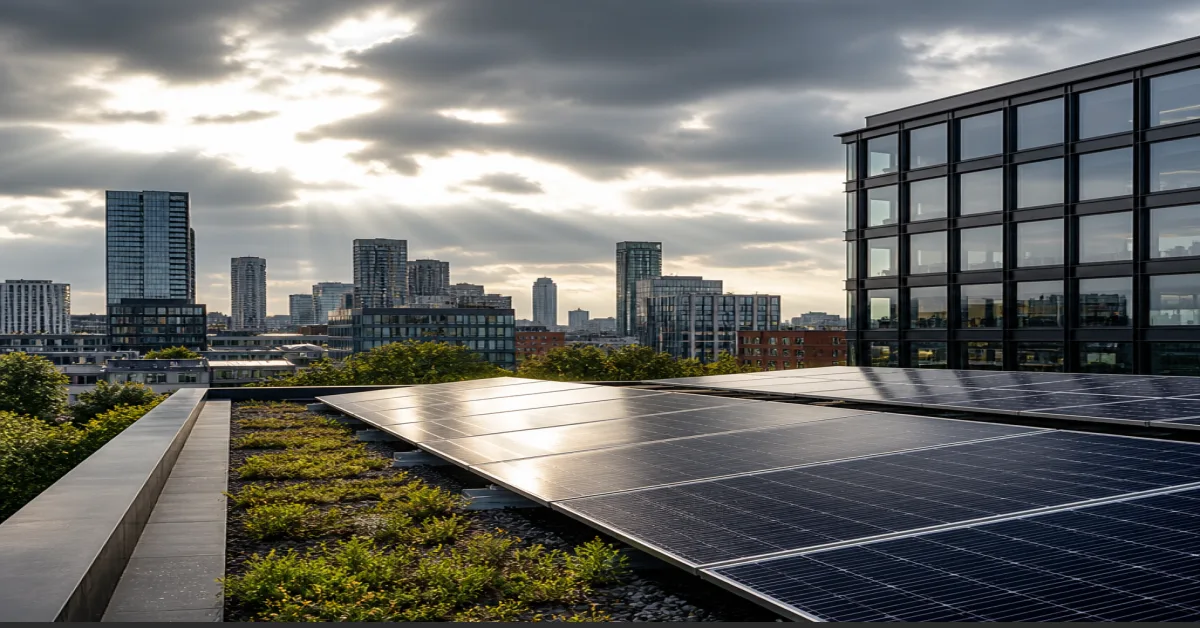
Office Building Solar Manchester | Bee Solar
Daytime office loads match solar output perfectly. Flat-roof systems, MCS-installed.
£34k/yr
Illustrative annual savings (150 kWp)
4.1 yr
Average payback period
28%
Consumption cut on-site
70%+
Self-consumption ratio
What's Covered on This Page
- Why Manchester Office Buildings Match Daylight Hours, Not Sunshine
- How Office Rooftop Solar Works on Manchester Commercial Buildings
- Office Demand Profiles vs Factories and Warehouses
- Permitted Development Rights for Office Rooftops in Manchester
- DNO Application, G99, and Electricity North West
- From Survey to Switch-On on Occupied Manchester Offices
- Monitoring, Self-Consumption, and Aftercare
- Frequently Asked Questions
Need Solar for Office Buildings?
0161 570 0596Get A Free Quote. Bee Commercial Solar is ready to help.
Why Manchester Office Buildings Match Daylight Hours, Not "Sunshine"
Solar panels generate electricity from daylight, including diffused light on overcast days, so direct sunshine is not a prerequisite for viability in Manchester. The city's frequent cloud cover reduces peak output compared with clear-sky conditions, but it does not stop generation; an overcast rooftop in Spinningfields still produces usable power throughout the working day. What makes Manchester offices commercially viable is the alignment between when your building draws power and when the panels generate it.
Office buildings run lights, HVAC, lifts, servers, and IT infrastructure from roughly 8am to 6pm. That is exactly when solar generation peaks, even under diffuse light. You consume the electricity on-site at full retail value rather than exporting it at lower rates. On a well-designed office system, self-consumption ratios of 70% or higher are the design outcome, not a weather miracle. The commercial logic is simple: every unit of solar electricity you use on-site replaces a unit you would otherwise buy from the grid at retail rates, while exports under the Smart Export Guarantee earn only the lower wholesale rate. This financial case has strengthened considerably as commercial electricity prices have roughly doubled since 2021, making the offset of retail-rate units even more valuable.
8am–6pm Load Match
Lights, HVAC, lifts and IT run when generation peaks for maximum self-consumption.
Diffuse-Light Generation
Overcast Spinningfields rooftops still produce usable power all working day.
Flat Parapet Roofs
Large clear city-centre roofs suit ballasted arrays with no penetrations.
Retail-Rate Offset
Every on-site unit replaces a grid unit at full retail value, not low export rates.
Manchester's office stock also works in your favour. Large flat roofs behind parapet walls are typical across the city centre and Greater Manchester, offering unused capacity that is structurally suited to ballasted arrays. These roofs are usually clear of chimneys and dormers, so more kilowatt-hours per square metre can be fitted than on most other building types. Neighbouring tower shading around Spinningfields or Peter Street is a survey check, not a deal-breaker; it is assessed before design freezes.
For a typical 150 kWp office installation, illustrative modelling shows savings around £34,000 per year, an average payback near 4.1 years, and a consumption cut of approximately 28%. Bee Solar also reports a 98% ESOS compliance support rate for office clients. These figures are typical modelling outcomes, not guaranteed returns; your actual numbers depend on roof dimensions, orientation, and consumption patterns. Call Bee Solar on 0161 570 0596 for a free site survey to see what applies to your building.
How Office Rooftop Solar Works on Manchester Commercial Buildings
A commercial office solar system is roof-mounted PV panels, inverters that convert DC to building AC, and a metering and monitoring setup that tracks generation, on-site use, and export. These three core parts work together to offset daytime electricity purchases, and the entire package is designed from your actual consumption data before any equipment is ordered. When evaluating hardware, a guide to choosing the right panel technology helps clarify the trade-offs between efficiency, warranty, and cost for your specific roof area.
Roof-Mounted Panels
Angled for year-round daylight on ballasted frames with no penetrations.
Inverters
Convert DC to usable AC, sized to your generation profile and infrastructure.
Metering & Monitoring
Real-time tracking of generation, consumption and export performance.
- Roof-mounted panels: Angled to capture maximum daylight across the year, mounted on ballasted frames on flat roofs with no penetrations, protecting the membrane and its warranty.
- Inverters: Convert DC power from the panels into AC power your building can use; sized to match your generation profile and electrical infrastructure.
- Metering and monitoring: Track generation, consumption, and export in real time, giving you visibility into system health and financial performance.
Ballasted frames are the default on Manchester office roofs. They hold panels at the correct tilt using weight alone, so no drilling is required and the roof membrane stays intact. Because office roofs tend to be clear of obstructions, more capacity can be fitted per square metre than on factories or warehouses with vents, ducts, and roof plant.
Office buildings also have stable, predictable load profiles. Unlike volatile industrial processes, office consumption follows a consistent weekday pattern, which makes pre-commitment generation modelling more accurate. Bee Solar owns the survey, design, and paperwork, including energy consulting and load-profile analysis, so the system is sized from half-hourly data where available, not generic assumptions. This means the quote you receive reflects your building's actual demand, not industry averages. Call 0161 570 0596 to discuss your building's fit.
Office Demand Profiles vs Factories and Warehouses
Offices draw most power 9am to 5pm, aligned with generation; retail buildings with matching peak demand show similar alignment.
| Factor | Office Buildings | Factories and Warehouses |
|---|---|---|
| Demand window | 9am to 5pm, weekday; aligned with generation | Shift-based, process-driven, often evening or weekend |
| Typical self-consumption | 70%+ on well-designed systems | Varies widely; may drop below 50% if loads sit outside solar hours |
| Weekend and export residual | Low weekend load; surplus exported under Smart Export Guarantee | Higher export volumes if shifts run nights or weekends |
| Modelling confidence | Stable, predictable weekday profile | Process loads create variance; modelling less certain |
Export under the Smart Export Guarantee pays lower tariffs than the retail rate you avoid through self-consumption. For offices, export is residual value, not the main financial case. Factories may export more unless their process loads run directly through the solar window, which is why office self-consumption logic typically delivers stronger payback. Real-world installations like industrial solar projects with different load profiles illustrate how these dynamics play out on the ground.
The practical implication is that an office system's financial case rests on offsetting bought electricity during the working day, not on selling generation back to the grid. If your office has a strong 9am-to-5pm load profile, every kilowatt-hour generated is doing maximum financial work. This is why the same panel array can deliver different returns on an office than on a factory, even in the same postcode.
Permitted Development Rights for Office Rooftops in Manchester
Most Manchester office rooftop PV installations fall under permitted development rights, so a full planning application is usually not required. This means your project can proceed without the time and cost of a planning committee, provided the installation meets the conditions attached to the rights.
200mm protrusion limit: Panels must not protrude more than 200mm from the roof surface or slope.
Listed buildings: Permitted development rights do not apply; full planning and potentially listed building consent are required.
Conservation areas: Areas near Deansgate and other protected zones follow different rules; the site survey checks this before design freezes.
Building height and location: Installations on buildings in designated areas or above certain heights may face additional restrictions; the survey confirms your specific status.
Permitted development is conditional, not automatic. The 200mm limit is the main technical condition, but conservation and listed status are the delay risks that catch building owners off guard. Bee Solar confirms whether your building qualifies under permitted development or needs full planning at the site survey, so there are no mid-project surprises. This check happens before any equipment is ordered or scaffolding is booked, so you are not committed to a design that cannot proceed. For a fuller picture of planning constraints and compliance requirements, the broader UK grid regulations provide essential macro-context.
DNO Application, G99, and Electricity North West
Systems over 3.68kW require a G99 application to the Distribution Network Operator, which for Manchester is Electricity North West, and Bee Solar submits and chases this paperwork on your behalf. The DNO application is usually the longest part of the project timeline, so understanding what a G99 application involves prevents unnecessary stalls.
G99 Submitted
Design, inverter specs and grid protection filed to Electricity North West.
Approval Window
Typical 4–6 weeks under 50kW; up to 8 weeks near busy substations.
Parallel Work
Structure, design freeze and ordering proceed while waiting.
- G99 application submitted: Bee Solar completes the technical submission to Electricity North West, including system design, inverter specifications, and grid protection details. The application confirms your system can export safely without destabilising the local network.
- Approval window: Typical turnaround is 4 to 6 weeks for systems under 50kW. Larger or constrained sites take longer; approvals have come back in under three weeks around Piccadilly and up to about eight weeks near busier substations such as Trafford Park. The DNO assesses local grid capacity and transformer headroom before issuing consent.
- Parallel work while waiting: Structural load assessment, panel and inverter design freeze, building management access dates, tenant notifications, and materials ordering all proceed during the DNO window so installation starts the moment approval lands.
Old supply boards should be flagged early. If your building has an older electrical distribution board, upgrading it later adds cost and delay, so Bee Solar identifies this during the survey and addresses it proactively. A supply board upgrade can be scheduled within the DNO waiting period, which keeps the overall programme on track. The DNO process is not something you chase yourself; it is installer-owned and tracked to completion.
From Survey to Switch-On on Occupied Manchester Offices
The survey-to-switch-on process follows six steps, with an overall programme of 8 to 14 weeks and the DNO application as the main variable. Installation days are short once approval lands, but the process must be sequenced correctly to avoid delays on occupied buildings.
Site Survey
Structural load, orientation, shading and cable routing assessed.
Design & Modelling
Consumption modelled against generation before anything is ordered.
PD & G99
Permitted development confirmed and G99 submitted.
Installation
3–5 days typical; 5–10 days for larger arrays, roof-first working.
Commissioning & MCS
Tested and MCS-registered for Smart Export Guarantee.
Handover
Monitoring dashboard walkthrough with live visibility.
- Site survey and roof assessment: Bee Solar checks structural load, roof orientation, shading from nearby structures, and cable routing. For offices around Spinningfields or Peter Street, neighbouring tall buildings are assessed for shadow cast at different times of day. The survey also confirms roof membrane condition and identifies any repairs needed before mounting begins.
- System design and energy modelling: Your actual consumption data is modelled against projected generation. You see panel count, expected output, and financial return before anything is ordered. Half-hourly consumption data improves model accuracy significantly compared with annual bill estimates.
- PD check and DNO/G99: Permitted development status is confirmed, and the G99 application is submitted to Electricity North West.
- Scaffold and installation: A typical office block takes 3 to 5 days; larger arrays take 5 to 10 working days depending on system size. Roof-first working means tenants and staff see minimal floor-level disruption. Noisy tasks happen before staff arrive or after they leave. Scaffolding is erected on the exterior, and panel mounting is completed without entering occupied floors.
- Commissioning and MCS certification: The system is tested and registered under the Microgeneration Certification Scheme, which is required to export surplus energy and earn from the Smart Export Guarantee.
- Handover and monitoring setup: You are walked through the monitoring dashboard so generation, consumption, and export are visible in real time.
Occupied-office logistics differ from warehouse projects. Access dates are agreed with building management, tenant notices are issued, and noisy work is scheduled outside working hours. The heavy work happens on the roof, not inside your offices. Lift access for equipment and cable routing through risers is planned in advance so installers are not waiting on building services. If upfront capital is a concern, alternative financing models like a solar PPA can remove the initial cost barrier while still delivering the benefits outlined here. Call 0161 570 0596 to book your survey.
Monitoring, Self-Consumption, and Aftercare
Generation continues without daily intervention, but peak financial performance depends on active monitoring of output, inverter health, self-consumption ratio, and export volumes. A system that is running is not necessarily performing at peak efficiency.
- Output vs expected yield: Panel-level generation is compared against expected yield for Manchester's climate data, flagging underperformance early.
- Inverter health: Efficiency readings across the day reveal faults before they cost money.
- Self-consumption ratio: Tracks how much generated power your building actually uses versus exports at lower tariffs.
- Export volumes: Verifies Smart Export Guarantee payments are accurate; metering discrepancies do happen, and monitoring catches them.
Practical scheduling also protects returns. High-draw equipment such as server cooling and EV chargers can be timed for midday generation where operations allow, shifting consumption into peak output hours and reducing export at low rates. This is a behavioural adjustment, not a technical one; the monitoring dashboard shows you exactly when surplus generation occurs so you can shift loads accordingly. Unmonitored string faults can sit for months, and export payment discrepancies occur; monitoring protects both yield and SEG income. Real-world experience demonstrates how active monitoring protects performance, with proactive maintenance recovering lost generation quickly. Regular performance reviews are included so you are not reviewing data alone. Call 0161 570 0596 to discuss monitoring setup for your system.
Book a Manchester Office Solar Survey
Call Bee Solar on 0161 570 0596 to book a free site survey and quote for your Manchester office building. The survey takes around 45 minutes, and a report is delivered within five business days.
Your building is a strong candidate if it has:
Large flat or shallow-pitched roof space, typical of Manchester office stock
High daytime HVAC, lighting, IT, or lift loads during 9am to 5pm
Usable roof area after shading and structural checks
A roof membrane in serviceable condition or scheduled for replacement, allowing solar to be coordinated with roof works
A survey may conclude that your building should wait. Structural failure, listed or conservation complexity, weak grid capacity, or low daytime load are all legitimate reasons to delay. That outcome is a risk reduction, not a failed sale. It prevents you from commissioning a system that would underperform or face planning obstacles later. Bee Solar follows the UK process: MCS-certified installation, Smart Export Guarantee registration, and Electricity North West G99 application. No US tax credits, no imported incentives, just the Manchester commercial solar process that applies to your building.
Frequently Asked Questions
Frequently Asked Questions
Does Manchester get enough daylight (not sunshine) to make office solar worthwhile?
Yes, Manchester gets enough daylight to make commercial solar financially worthwhile. Solar panels generate power from daylight, including diffused light on overcast days; direct sunshine is not required. Manchester's high commercial electricity rates mean savings accumulate faster than many building owners expect, and office demand aligns with generation hours.
Can you put solar panels on commercial office buildings in Manchester?
Yes, most Manchester office buildings can host rooftop solar, provided the roof has structural capacity, usable area after shading checks, and daytime electricity demand. Ballasted flat-roof arrays are standard practice and require no roof penetrations.
Do I need planning permission, or do permitted development rights cover office rooftops?
Most Manchester office rooftops fall under permitted development rights, so full planning permission is not usually required. Panels must not protrude more than 200mm from the roof surface. Listed buildings and conservation areas near Deansgate follow different rules and are checked at survey.
What is the DNO / G99 process with Electricity North West and how long does it take?
Any system over 3.68kW needs a G99 application to Electricity North West, Manchester's Distribution Network Operator. Typical approval takes 4 to 6 weeks for systems under 50kW; larger or constrained sites take longer. Bee Solar submits and chases the application on your behalf.
How long does the process take from survey to switch-on?
Most Manchester office solar projects take 8 to 14 weeks from initial survey to switch-on. The DNO application is the main variable; installation itself takes 3 to 10 working days depending on system size.
How do office demand profiles compare with factories for self-consumption?
Offices draw most power during 9am to 5pm when solar generation peaks, achieving self-consumption ratios of 70% or higher on well-designed systems. Factories often run shift or process loads outside solar hours, increasing exports at lower tariff rates.
What percentage of office electricity can a well-designed system cover on-site?
A well-designed system on a Manchester office building regularly achieves self-consumption ratios of 70% or higher. Because office peak demand aligns with peak generation, electricity is used as it is made, reducing bought electricity significantly.
Will solar damage a flat roof or require drilling?
No. Flat roof installations use ballasted mounting frames that sit on the roof surface and hold panels at the correct angle using weight alone. This is standard practice and protects the membrane and its warranty.
How do we know generation before we commit?
Bee Solar models expected generation from your actual consumption data, roof dimensions, and orientation before any equipment is ordered. Office buildings have stable, predictable load profiles, which makes the modelling accurate. You see projected figures for your specific property before signing anything.
Do US solar tax credits or a "33% rule" apply to Manchester offices?
No. US tax credits and the "33% rule" do not apply to UK commercial installations. Manchester offices follow UK rules: MCS certification, Smart Export Guarantee, and Electricity North West G99 applications.
Who handles grid paperwork and occupied-building disruption?
Bee Solar handles the full G99 submission to Electricity North West and chases progress so your project does not stall. Installation is roof-first, noisy work is scheduled outside working hours, and tenant notices are coordinated with building management.
Ready to Explore Solar for Your Office Building?
We will survey your site, model your savings, and present a tailored proposal — no obligation, no pushy sales calls.
Typical survey takes 45 minutes. Report delivered within 5 business days.