
Farm Solar Panels: Cut Costs | Bee Solar
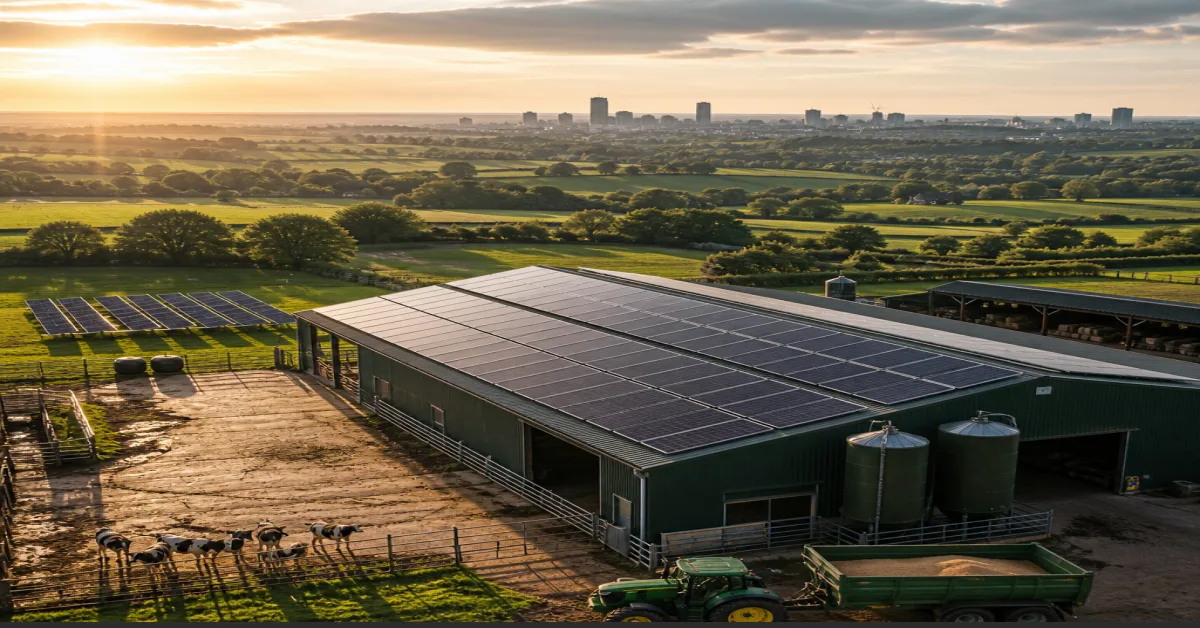
Farm buildings have ideal roofs for solar. 200 kWp dairy reference site in Cheshire.
£48k/yr
Illustrative annual savings (200 kWp)
4.2 yr
Typical payback period
72%
Daytime load offset
65 tCO2e
Annual carbon saving
What's Covered on This Page
- Agricultural Solar Panels as a Second Crop on Greater Manchester Farms
- High-Load Offsets: Grain Drying, Dairy Cooling, and Irrigation
- Four Farm Objections: Green Belt Planning, Old Roofs, Seasonal Cash Flow, Livestock Ventilation
- Roof Mount vs Ground Mount (and Hybrid) for Agricultural Solar Panels
- How Bee Solar Surveys, Designs, and Installs Farm Solar in Greater Manchester
- Farm Funding, Tax Relief, and SEG (Eligibility Caveats)
- Farm Solar Readiness Checklist and Estimate Caveats
- Frequently Asked Questions
Need Solar for Agriculture & Farming?
0161 570 0596Get A Free Quote. Bee Commercial Solar is ready to help.
Agricultural Solar Panels as a Second Crop on Greater Manchester Farms
UK agricultural solar panels are rooftop and/or ground-mounted photovoltaic systems on working farms, sized to offset daytime loads such as grain drying, dairy cooling, and irrigation, and installed as a surveyed local service. Unused barn roofs, and optional high-clearance ground, produce a yearly kWh and £ harvest without taking land from the main crop—the second crop pays alongside the first.
For a typical 200 kWp profile, expect the following scale, caveated by tariff, self-consumption, structure, and DNO capacity:
- Roof area: ~2,800 m²
- Generation: ~190,000 kWh/year
- Savings: ~£48,000/year
- Payback: ~4.2 years
- Daytime load offset: 72%
- Carbon saving: 65 tCO2e/year
These figures are modelled as a typical example for a farm with strong daytime consumption. Your actual payback will vary with your tariff, how much generation you use on site, roof condition, and grid connection capacity. Bee Solar surveys farms across Greater Manchester and the surrounding rural catchments, including Cheshire and Lancashire-style holdings. The on-farm survey takes about 45 minutes, with a report delivered within approximately 5 business days. This service is for farm owners and agricultural business managers cutting electricity and diesel overheads on dairy, arable, mixed, livestock, and horticulture sites. Barn PV uses the existing footprint, which means zero productive land loss, unlike field-based solar. A direct reference to a similar scale is the Hollowbrook Farm dairy project.
High-Load Offsets: Grain Drying, Dairy Cooling, and Irrigation
Grain drying, dairy cooling and milking, and irrigation are high-power, daylight-aligned loads; solar generation peaks with harvest and summer pumping. Farms with these loads are the strongest candidates because they consume the power on site rather than exporting it at low rates.
Crop Drying
80–150 kW dryers offset 60–80% in daylight; night drying needs grid or battery.
Dairy Cooling
Parlours and refrigeration align with daytime generation for 72% offset.
Irrigation
Solar-direct pumps replace diesel, cutting fuel cost and noise.
Three-Phase Ready
Common farm supply reduces DNO friction, subject to survey.
Crop drying: Continuous-flow dryers typically draw 80–150 kW and run intensively during late-summer daylight, exactly when PV output is highest. A 200 kWp array can offset 60–80% of harvest dryer electricity during daylight hours. Night drying requires grid supply or battery storage using afternoon surplus, so a dryer running around the clock will still draw from the grid after dark.
Dairy cooling and milking: Parlours, refrigeration, and packhouses align with daytime generation, making dairies a natural match for solar. The typical dairy profile is a 72% daytime offset and 65 tCO2e annual saving, matching the same 200 kWp example, not every farm. Herds milked twice daily see two distinct demand peaks that PV can cover during daylight sessions.
Irrigation: Solar-direct pumps replace diesel generators, cutting fuel cost and noise, and removing the need to store and handle fuel near water sources. Optional diesel-spend modelling is included on survey so you can see the fuel offset in cash terms, not just kWh.
Winter generation is lower, but farm loads also drop, which supports year-round self-consumption rates. Three-phase supply is already common on farms, which can reduce DNO upgrade friction for larger inverters, subject to survey confirmation. Large unshaded south-facing agricultural roofs often perform 10–15% better than urban installations, though this is typical and orientation-dependent—a north-facing or shaded barn will not achieve this.
Four Farm Objections: Green Belt Planning, Old Roofs, Seasonal Cash Flow, Livestock Ventilation
Green Belt and rural planning
Agricultural solar on existing farm buildings typically uses GPDO Class A permitted development rights, but this is not automatic. Barns over 25 years old or sites in sensitive landscapes such as AONBs require rural impact assessments covering agricultural need, farm-business benefit, and landscape impact. Ground-mounted systems need a full planning application and are often assessed as agricultural diversification rather than permitted development.
Old, asbestos, or 1970s corrugated roofs
Survey before design. Lightweight frames with distributed load can work on asbestos-cement roofs where viable, spreading weight across purlins rather than concentrating it. For degraded roofs, recladding with insulated steel and integrating solar in one visit is the practical route, avoiding a second scaffolding contract and giving you a better-insulated building as part of the same project. Ground-mount is a fallback, with a ground-mount option identified on 95% of farm sites surveyed; this reflects survey findings, not a universal guarantee. A roof that fails structural assessment should not be pushed into service—the ground array may be the lower-risk path.
Seasonal cash flow
Harvest-aligned payments, seasonal leases, and Power Purchase Agreements (PPAs) let you pay only for consumed solar kWh rather than funding the full capital cost upfront. Batteries plus SEG tariffs can generate summer surplus income in the months when generation exceeds demand. Typical 200 kWp summer export is £6,000–£10,000, tariff-dependent, and this is separate from the savings you bank from offsetting daytime loads. There is no Feed-in Tariff to claim; the FIT scheme closed to new applicants, and SEG is the current export route.
Livestock ventilation and welfare
Preserve ridge vents, use setbacks, and specify elevated mounts to maintain airflow under the array. Panel-shaded cladding can create a 2–4°C cooler microclimate in summer, but this is a design note, not a welfare guarantee. Farm-building specialists treat humidity and animal welfare as design constraints—the same array that cools a dairy building in July must not obstruct winter airflow or trap moisture against the cladding.
The process involves early officer engagement, photomontages, structural certificates, and agricultural justification. Bee Solar's 100% planning success rate on farm installations is a claimed track record supported by a documentation process, not a guarantee of permission for your site. Every application is judged on its own merits, and engaging the local planning authority before submission is the single most effective way to reduce refusal risk.
Roof Mount vs Ground Mount (and Hybrid) for Agricultural Solar Panels
Most farms can use both. Bee Solar typically recommends a hybrid approach: barn roofs for low-disruption generation plus a small high-clearance ground array for extra kWp capacity where the roof cannot deliver enough power.
| Factor | Roof Mount | Ground Mount |
|---|---|---|
| Planning | Usually permitted development on existing buildings, not automatic | Full planning application, often as agricultural diversification |
| Land use | Zero productive land loss | ~1–2 acres per 250 kWp; 2.5m+ clearance for sheep grazing or storage |
| Cost bands | £1,100–£1,400 per kWp | £1,300–£1,700 per kWp |
| Size potential | Often 100–300 kWp per building set | Scalable; 1 acre supports ~250–300 kWp |
| Access and maintenance | Requires safe roof access or cherry picker | Ground-level access, easier and safer |
| Yield | Follows roof pitch, typically 10–25° | Optimised ~30° south, typically 8–12% higher yield per kWp |
| Best for | Dairy and arable farms with large barns | Mixed and livestock farms with limited roof space |
Panel choice comes down to weight, warranty, airflow, and tilt and orientation, not brand ranking. A bifacial panel on a high-clearance ground array can capture reflected light from grazing sward below, but the same panel on a low-pitch barn roof gains little from this. Opposition to solar on farmland rarely applies to barn PV or grazing under elevated arrays—the land beneath a high-clearance ground mount remains productive for sheep, which is why most objections to field solar dissolve when the array is raised. A free survey models the combined ROI of both mounting options. For a broader sector view, you can see how agricultural sites compare with other commercial sectors.
How Bee Solar Surveys, Designs, and Installs Farm Solar in Greater Manchester
Bee Solar provides turnkey agricultural PV, load modelling, farm-aligned finance, and a funding audit on survey. The process is designed around farm operations, not a generic commercial install:
Enquiry
Via phone or website to start your farm survey.
On-Farm Survey
Approximately 45 minutes covering roof, shading and electrics.
Design & Modelling
Structural, shading and half-hourly load modelling.
Report in 5 Days
Generation forecast, savings model and funding routes.
DNO & MCS
Three-phase capacity and export limits confirmed.
Install & Commission
Planned around harvest, with certificates and SEG.
- Enquiry via phone or website.
- On-farm survey, approximately 45 minutes, covering roof condition, orientation, shading, and existing electrical infrastructure. This is supported by energy consulting services for a deeper audit.
- Structural, shading, and half-hourly load modelling—this is where the 72% offset figure is tested against your actual consumption data. This technical stage is handled through solar design services.
- Report delivered within about 5 business days, including generation forecast, savings model, and funding routes.
- DNO and MCS pathways managed in parallel; three-phase capacity and export limits confirmed before any equipment order.
- Install window planned around harvest disruption and livestock; drying season and calving blocks are avoided wherever possible.
- Commissioning, electrical certificates, insurer pack, SEG registration, and aftercare. This final step includes ongoing maintenance plans to protect long-term performance.
Local delivery accounts for rural access, yard constraints, barn types, three-phase and DNO capacity, and Green Belt or rural planning authority requirements. Reference project: Hollowbrook Farm Dairy in Nantwich, Cheshire, a 200 kWp installation offsetting 72% of daytime demand—this is a supplied case example, not a promise that every dairy achieves the same result.
Risk is reduced by structural survey before design, preserving ridge vents, avoiding oversizing for export-only, MCS certification, and never installing field arrays without planning. Related services include commercial installation, energy consulting, solar financing, and funding and incentives. To start, book a free site survey on 0161 570 0596 for a no-obligation proposal.
Farm Funding, Tax Relief, and SEG (Eligibility Caveats)
The Feed-in Tariff is closed. The remaining routes each have strict who-qualifies rules, and not every farm will qualify for every route. The survey includes a funding audit that matches your holding type to the routes you can actually use.
- Salix: 0% loans for publicly owned farms, agricultural colleges, and council-run estates. Private commercial farms do not qualify directly.
- Countryside Stewardship: For farmers with a Single Business Identifier (SBI); solar qualifies only where linked to operational or environmental need. Annual windows and Farm Environment Plan evidence required.
- Annual Investment Allowance (AIA): 100% first-year relief on plant and machinery, capped at £1m (2024–2025). All UK farm business types qualify if installed within the accounting period.
- Enhanced Capital Allowances (ECA): Only if equipment is on the Energy Technology List at purchase. Your accountant claims this alongside AIA with a Bee Solar invoice split.
- RDP and LEADER: Locally administered by Rural Action Groups; typically 40–60% match funding. Awards are not guaranteed and require diversification framing.
- Smart Export Guarantee (SEG): Requires MCS certification and a smart meter. Rates vary by supplier; a 200 kWp system exporting 35,000 kWh annually generates £2,500–£6,000, tariff-dependent.
Insurance: panels usually classify as fixtures covered under agricultural building policies. Certificates and structural sign-off satisfy insurer requirements; some insurers offer premium discounts, but this varies. A free survey includes a full funding review.
Farm Solar Readiness Checklist and Estimate Caveats
Score your site against these six readiness factors:
South-facing barn roof
High daytime loads (milking, drying, cooling, irrigation)
Existing three-phase supply
Roof condition adequate or ground-mount viable
Permitted development or rural planning path (not automatic)
Seasonal cash flow manageable with farm finance
Six ticks means a perfect fit. Four to five indicates highly suitable. Two to three is promising. Zero to one needs a survey.
Online calculators use simplified UK averages. A real proposal requires half-hourly data, shading analysis, and structural assessment—the gap between a calculator estimate and a site-specific model is often 10–20% on generation and more on payback. While you can estimate your own returns with our tool, a full survey is needed for accurate figures. Payback is always tied to system size, with 200 kWp as the reference example. Useful inputs include farm type, electricity bill, roof area, diesel pump spend, and dryer hours. Even with only two or three ticks, a survey can reveal ground space, grid headroom, or grant fit that changes the picture—a mixed farm with a poor roof and no three-phase may still be a strong candidate once a ground array and DNO capacity check are added to the model.
Frequently Asked Questions
Frequently Asked Questions
What are agricultural solar panels on UK farms?
Agricultural solar panels are photovoltaic systems installed on farm buildings or land, sized to offset daytime electricity loads such as grain drying, dairy cooling, milking, and irrigation. They are installed as a surveyed local service, not as theoretical co-location.
Can solar power grain dryers during harvest?
Yes. Continuous-flow grain dryers typically draw 80–150 kW and run intensively during daylight in late summer, matching peak solar generation. A 200 kWp array can offset 60–80% of harvest dryer electricity. Night drying uses grid supply or battery storage from afternoon surplus.
Do I need planning permission for solar on Green Belt farm buildings?
Not always. Existing farm buildings typically fall under GPDO Class A permitted development. Barns over 25 years old or in sensitive landscapes such as AONBs require rural impact assessments. Ground-mounted systems always need a full planning application. Approval is never automatic.
Is there a 33% rule for farm solar in the UK?
No. There is no defined 33% cap in UK legislation. The actual constraints are GPDO Class A conditions, landscape impact assessments, and building coverage limits. A planning officer determines each case. If you see a 33% figure quoted elsewhere, treat it as unverified—the real test is the planning authority's assessment of your specific site.
Why are people against solar on farmland and does barn-roof solar take productive land?
Opposition targets field-based solar farms that remove land from food production. Barn-roof solar uses zero productive land because it mounts on existing buildings. High-clearance ground arrays can permit grazing or storage beneath, keeping land in use. The land-use debate loses force when the array is on a roof or raised 2.5m above grazing sward.
Which solar panel is best for agriculture?
Selection depends on roof weight capacity, warranty, airflow under the array, and tilt orientation. There is no single best brand. The survey specifies panels suited to barn structure and livestock ventilation needs. For ground mounts, bifacial panels with high clearance can capture reflected light; for roof mounts, panel weight is the dominant constraint.
How much solar can you put on 1 acre of unused farm land?
Approximately 250–300 kWp per acre. Cost is calculated per kWp, typically £1,300–£1,700 for ground mounts. A survey confirms site-specific viability and planning path.
What about ground-mount solar on unused farm land?
Ground mounts work where roof space is limited. With 2.5m+ clearance, land beneath can graze sheep or store equipment. They require full planning permission, usually justified as agricultural diversification. They are typically 8–12% higher yielding per kWp than roof mounts because the tilt angle is optimised, but the higher installed cost per kWp partially offsets this.
Are there grants specifically for farm solar?
The Feed-in Tariff is closed. Current routes include Countryside Stewardship capital grants, RDP and LEADER funds, annual windows permitting, AIA 100% first-year tax relief, and ECA where equipment is on the Energy Technology List. Salix loans are not available to private commercial farms directly.
Will solar panels affect my farm insurance?
Panels are typically classified as building fixtures covered under agricultural building policies. Bee Solar provides installation certificates, electrical compliance documents, and structural sign-off required by insurers. Some insurers offer premium discounts for monitored systems, but this varies by provider.
Will panels block ridge ventilation in livestock buildings?
No, if designed correctly. Panels are set back from ridge vents and elevated to maintain airflow beneath the array. This preserves ventilation paths and can reduce solar heat gain on the roof cladding. The design must account for humidity and stocking density, not just panel output.
Can farm solar work with seasonal cash flow?
Yes. Harvest-aligned payment schedules, seasonal leases, and PPA models let you pay for consumed kWh only. Batteries plus SEG tariffs can generate summer export income when generation exceeds farm demand.
Should we add batteries for night drying and SEG export?
Add batteries if night drying shifts are regular or if summer surplus is significant. Batteries capture afternoon generation for evening discharge. Without batteries, surplus exports automatically under SEG. The decision depends on your load profile and tariff—a dairy with night milking will see more battery benefit than an arable farm that only dries in daylight.
Roof mount, ground mount, or hybrid, what should Greater Manchester farms choose first?
Choose roof mount first where structure allows, because it uses existing footprint with lower cost per kWp. Add a small ground array for extra capacity. Most farms benefit from a hybrid approach, confirmed by a free on-farm survey.
Ready to Explore Solar for Your Farm?
We will survey your site, model your savings, and present a tailored proposal — no obligation, no pushy sales calls.
Typical survey takes 45 minutes. Report delivered within 5 business days.