
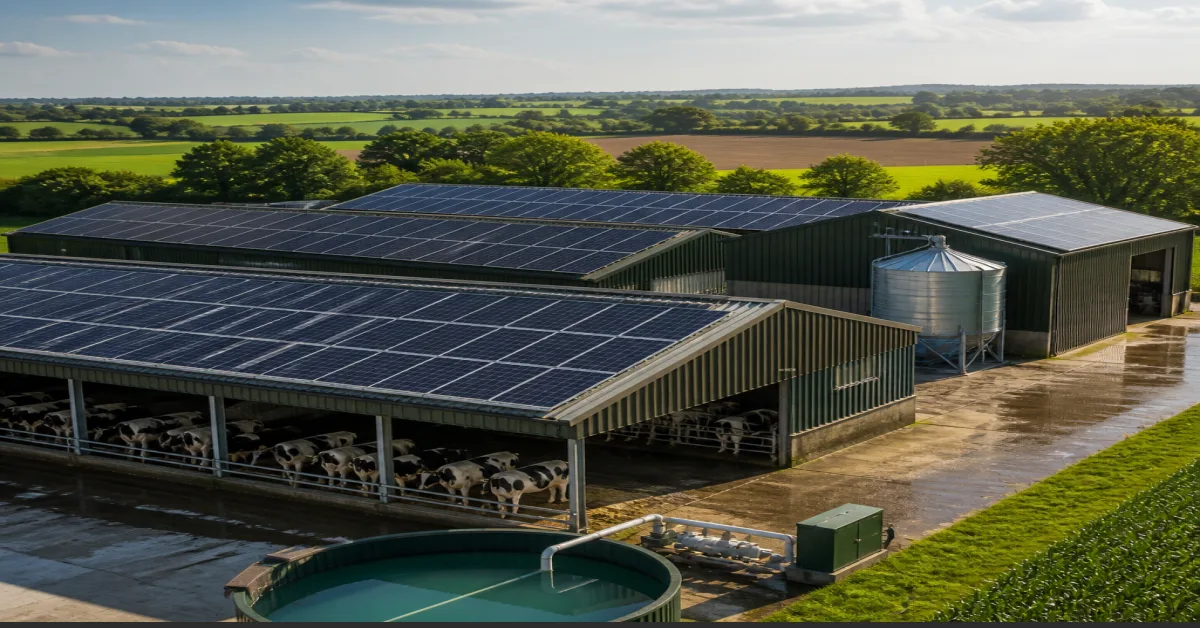
Agricultural Solar Installation: 200kWp Dairy Farm Case Study
See how Bee Solar delivered a 200kWp agricultural solar installation in Cheshire, reducing annual energy bills by £48,200 for a dairy farm.
Client
Hollowbrook Farm Dairy
Location
Nantwich, Cheshire
System Size
200 kWp / 100 kWh Battery
Completed
2024
Working Dairy Rooftop PV at Hollowbrook Farm, Nantwich — Not a Field Solar Farm
An agricultural solar installation on a UK dairy farm means rooftop photovoltaic (PV) panels on working farm buildings to offset parlour, refrigeration, drying and pumping loads — not necessarily a field solar farm. This 200 kWp case study covers Hollowbrook Farm Dairy in Nantwich, Cheshire, a 400-cow dairy completed in 2024 by Manchester-based Bee Solar.
The array spans three barns and a grain store, offsetting 72% of daytime farm electricity demand including the milking parlour, refrigeration and grain drying, plus a solar-direct irrigation pump for the 120-acre arable rotation. This is a Challenge–Solution–Result case; all quantified figures apply to this 200 kWp scale only. To be clear: 1-acre or “33% rule” land-lease questions describe a different product. This 200 kWp used existing barn and grain-store roofs and took no land out of production. The milk, arable crops and livestock continue to use every square metre of the holding.
- This project is: A 200 kWp rooftop PV + 100 kWh battery on a 400-cow working dairy.
- This project is not: A field solar farm, land-lease development, or loss of productive acreage.
- Provider: Bee Solar, Manchester-based agricultural team. Next step: free site survey or 0161 570 0596.
The Challenge: £72,000 Loads, 1980s Corrugated-Steel Barns, and Cow Welfare
The 400-cow dairy consumed over £72,000 in electricity annually, with the milking parlour and bulk tank refrigeration accounting for 58% of total demand. The farm had three large 1980s corrugated-steel barns with south-facing roofs, plus a grain store that served both as a drying load and potential array surface. Grain drying alone is one of the most power-hungry seasonal loads on a dairy and arable unit, which made the store an obvious second surface rather than an afterthought.
The decision frame was simple: keep paying grid prices, or install rooftop PV without harming livestock and without taking land out of production. Think in kWh loads, not panel counts — parlour, bulk tank, grain drying and irrigation are the loads that justify the array. A common shortcut is to quote a system size from roof area alone; here the system was sized against a measured load profile first, then matched to available roof space.
Key Constraints
- Annual electricity cost: £72,000+, parlour + refrigeration 58%
- Structural integrity of 1980s corrugated steel
- Ridge ventilation must be preserved for cow welfare
- Disruption risk around the milking routine
Solution: Structural Assessment of 1980s Corrugated-Steel Barns
Bee Solar’s agricultural team conducted a full structural assessment and designed a lightweight mounting system with distributed ballast loads suitable for the existing roof profile. The assessment confirmed the 1980s steel could carry the array only because the load was spread rather than concentrated — a detail that matters when a barn is still in daily livestock use.
Full structural assessment
Condition of steel sheets, purlins and frame connections checked to confirm load capacity before any design commitment.
Lightweight mounting
Mounting system matched to the existing roof profile, avoiding unnecessary additions to the dead load.
Distributed ballast
Weight spread across the structural grid so no single bay is overloaded — not a domestic overlay approach.
This delivered 200 kWp across three barns and the grain store at the designed scale. Skipping the structural survey is a common mistake; if a survey cannot support the design, a responsible installer will not promise the array.
Solution: Livestock-Safe Frames That Preserve Ridge Ventilation
Panels were elevated on livestock-safe frames that preserved all ridge ventilation slots. Ridge ventilation was a non-negotiable welfare constraint on this 400-cow dairy, so the design sequence put the frames and vent preservation first, with panel shading as a welfare-relevant design outcome quantified in the results.
Ventilation preserved
Elevated frame height keeps airflow moving along the full ridge line, so lying and feeding areas receive the same passive ventilation as before.
Shading benefit
Covering ridge vents is a common installer mistake; this design avoided it entirely, delivering 3°C cooler barns under panel shading.
Solution: 100 kWh Battery and Solar-Direct Irrigation Pump
The 200 kWp array was paired with a 100 kWh battery to capture afternoon surplus for evening milking. A solar-direct irrigation pump was then added to the dairy yard to serve the 120-acre arable rotation.
| Decision | Alternative | Chosen on Hollowbrook |
|---|---|---|
| Array location | Ground-mount field farm | Rooftop on existing buildings — land stays in production |
| Storage | Solar-only | Solar + 100 kWh battery for evening milking |
| Irrigation | Diesel irrigation | Solar-direct pump — diesel costs eliminated |
The battery exists because milking demand extends beyond daylight hours, and the pump is a second electrical substitution rather than simply “more panels.” The irrigation pump draws directly from the array during daylight, so water moves across the 120-acre rotation without a diesel tank ever being filled for that job — a separate saving from the £48,200 electricity reduction.
Planning Realism and Farm Suitability (Cheshire Delivery)
Planning for this project was approved under permitted development in 3 weeks — this case only, not a universal SLA. See our commercial solar installation service for the wider scope. For other agricultural operations exploring similar options, explore our agricultural solar solutions to see how rooftop PV can be adapted to your specific farm buildings.
South-facing barns
UK dairy or estate with south-facing barns ideal for rooftop PV.
High daytime loads
Parlour, refrigeration, drying and pumping loads that match solar generation.
Survey-first
Willingness to start with a structural survey before any design commitment.
This page does not promise 1-acre field developments, US tax credits, invented acreage costs, or guaranteed 3-week planning for every farm. Manchester-based Bee Solar completed this Nantwich, Cheshire dairy in 2024.
Results at 200 kWp: £48,200 Saving, 72% Daytime Offset, 3°C Cooler Barns
To ensure these performance savings are maintained over the system's lifetime, commercial solar monitoring services can track output and verify that the array continues to perform at its designed capacity.
Annual electricity bill reduced by £48,200 (67%)
Daytime farm load offset increased to 72%
Diesel irrigation pump costs eliminated entirely
Barn interior temperatures reduced by 3°C under panel shading
Carbon footprint reduced by 65 tonnes CO2e annually
| Metric | Result |
|---|---|
| Annual electricity bill reduction | £48,200 (67%) |
| Daytime farm load offset | 72% |
| Diesel irrigation costs | Eliminated entirely |
| Barn temperature | 3°C cooler under shading |
| Annual carbon reduction | 65 tonnes CO2e |
That 3°C reduction is tied to preserved welfare and panel shading, not a generic eco claim. In a summer with high-yielding cows, a 3°C drop reduces heat stress, which supports feed intake and milk yield. These figures apply to this 200 kWp Hollowbrook installation only.
Other Commercial Scales Bee Solar Has Delivered
Bee Solar delivers commercial rooftop solar across building types, not only dairy farms.
250 kWp Warehouse
Mersey Logistics Ltd, Liverpool, Merseyside.
Boutique Hotel
Cotswold Country House Hotel, Cheltenham, Gloucestershire.
The same commercial rooftop discipline applies across these scales, but warehouse or hotel kWp figures should not be read as dairy savings.
Book a Free Site Survey for Your Agricultural Solar Installation
Every project starts with a free site survey. Start Your Project by calling 0161 570 0596.
Survey
Structural and welfare constraints assessed on your barns, grain stores and electrical loads.
Quotation
Sized to parlour, refrigeration, drying and pumping loads — not roof area alone.
Installation
Installed around working-farm realities and the milking routine without harming livestock.
Aftercare
Understanding ongoing solar maintenance needs is part of that aftercare plan, ensuring your system continues to perform efficiently for decades.
Bee Solar, based in Manchester, delivers agricultural and commercial rooftop systems as proven at Nantwich. A survey-first approach prevents unsurveyed steel, covered vents, and mis-sized arrays.
Frequently Asked Questions
What is an agricultural solar installation on a UK dairy farm if it is not a field solar farm?
It is rooftop PV on working farm buildings — barns, grain stores, parlour roofs — sized to offset on-farm electrical loads rather than land-lease generation.
Can solar go on 1980s corrugated-steel dairy barns?
Yes, when a full structural assessment confirms capacity and a lightweight mounting system with distributed ballast is designed for the existing roof profile. The survey must come first; if the steel cannot support the array, the project should not proceed.
How was ridge ventilation kept for cow welfare on this Cheshire array?
Panels were elevated on livestock-safe frames that preserved all ridge ventilation slots, so airflow and cow welfare were not compromised. The barns measured 3°C cooler under shading after installation.
What results did the 200 kWp Hollowbrook Farm Dairy system actually deliver?
A £48,200 (67%) annual bill reduction, 72% daytime load offset, eliminated diesel irrigation costs, 3°C cooler barn interiors, and 65 tonnes CO2e saved annually.
Did this 200 kWp project use a battery, and why?
Yes, a 100 kWh battery captures afternoon surplus for evening milking, because parlour demand extends beyond daylight hours.
How did the solar-direct irrigation pump change the 120-acre arable rotation?
The pump runs directly from the array, eliminating diesel costs for irrigation across the rotation. It uses daylight generation for water movement, a separate saving from the electricity bill reduction.
Is a rooftop dairy array the same as a 1-acre solar farm or the “33% rule”?
No. This 200 kWp used existing barn and grain-store roofs and took no land out of production; acreage rules apply to field-based solar farms, not barn rooftops. If you are comparing field-farm rules against barn PV for your own holding, ask for UK planning advice at survey.
How long did planning take for this Nantwich permitted-development rooftop job?
Planning was approved under permitted development in 3 weeks for this project only; timelines vary by site.
Does Bee Solar survey and install agricultural solar from Manchester into Cheshire?
Yes. Bee Solar is Manchester-based and completed this Nantwich, Cheshire dairy installation in 2024.
Who is a good fit for a free agricultural solar site survey?
UK dairy or estate owners with south-facing barns, high daytime electrical loads across parlour, refrigeration, drying or pumping, and a willingness to start with a structural survey.
Want Results Like This?
Every project starts with a free site survey. Let us show you what solar can do for your farm buildings.