
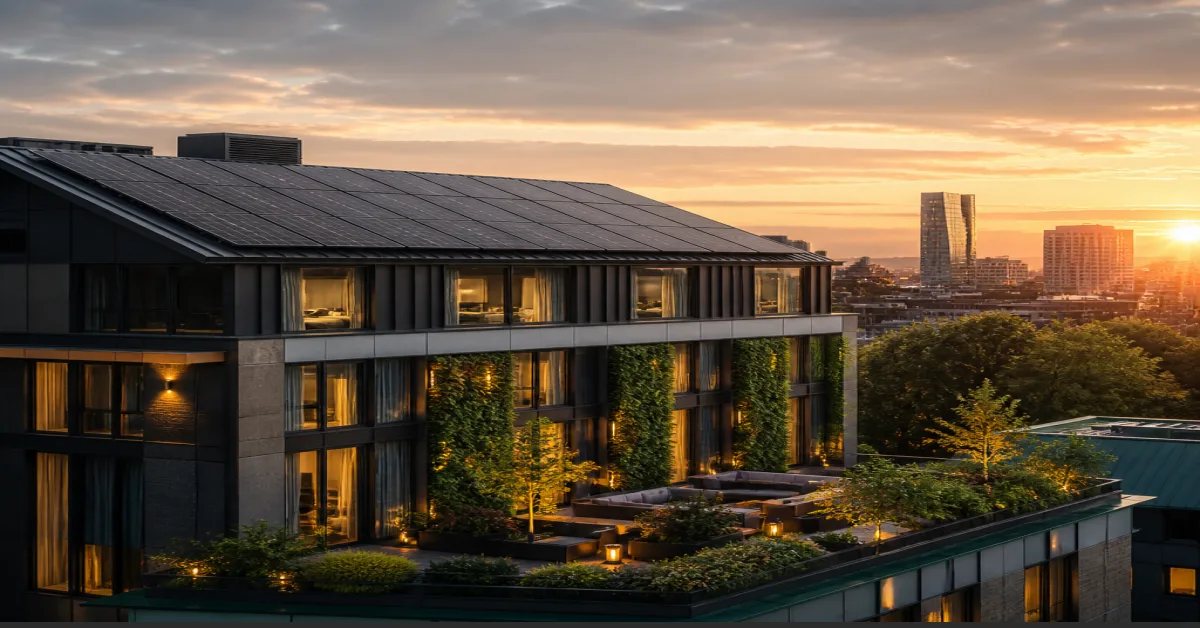
Hotel Solar Panels Manchester | Bee Solar
Large flat roofs plus high daytime loads make hotels ideal. EPC, battery and EV options.
£38k/yr
Illustrative annual savings (150 kWp)
4.8 yr
Average payback period
52 tCO2e
Annual carbon offset
68%
Daytime load offset
What's Covered on This Page
- Hotel-Scale Economics: Typical Savings, Payback, SEG and Capital Allowances
- Why Hotel Load Profiles in Manchester Suit Rooftop PV
- Is Your Manchester Hotel Roof and Electrical Supply Suitable?
- Planning Permission and Electricity North West (DNO) G99 for Hotel Solar
- Installation Programme: Survey to Switch-On Without Guest Disruption
- EPC Ratings, MEES, Monitoring and Hospitality Roof Aftercare
- Why Bee Commercial Solar for Greater Manchester Hotels
- Frequently Asked Questions
Need Solar for Hotels?
Call 0161 570 0596
Get A Free Quote. Bee Commercial Solar is ready to help.
Hotel-Scale Economics: Typical Savings, Payback, SEG and Capital Allowances
A typical modelled 150 kWp hotel solar system in Greater Manchester is associated with around £38,000 in annual savings and a 4.8-year average payback period. These are typical modelled hospitality figures, not a guarantee; a half-hourly data assessment is required to confirm your property's specific returns. For a more detailed breakdown of the starting figures, you can refer to a typical 2026 Manchester cost-per-kW benchmark.
The economics work because hotels run high daytime electrical loads. Kitchens, laundry, HVAC, and back-of-house operations align with solar generation hours. A system sized for this demand can offset roughly 68% of daytime hospitality load. The annual carbon offset is around 52 tCO2e, a useful reporting figure, though not the primary sales driver.
Under the Smart Export Guarantee (SEG), surplus electricity can be sold to a licensed supplier during low-occupancy periods. This is secondary to on-site bill reduction. Export income helps in quiet midweeks, but self-consumption of daytime load is the main return driver, not the payback story. For a deeper dive into the revenue mechanics, read a detailed guide to the SEG scheme. The 4.8-year payback assumes strong self-consumption; a property that exports most of its generation will see a longer return period.
Capital allowances let you offset qualifying system costs against taxable profits in year one. This improves first-year cash flow. For a 150 kWp system, this can represent a meaningful reduction in the net upfront cost, though the exact figure depends on your business structure and taxable position. For precise treatment, confirm details with your accountant.
The numbers become real through energy consulting. Bee Commercial Solar maps your half-hourly demand against generation curves before any design work, using your actual bills rather than generic profiles. This half-hourly comparison is what separates a realistic payback projection from an estimate based on national averages.
Call 0161 570 0596 for a desktop assessment, then book a survey with your bills ready.
Why Hotel Load Profiles in Manchester Suit Rooftop PV
Hotels run high daytime electrical loads that align directly with solar generation. Kitchens start before breakfast service, laundry runs through the morning, HVAC works across the day, and reception areas need lighting and power from early hours. This daytime base load means a solar array earns its keep while the sun is up.
Energy bills for Manchester hotels have jumped by over 40% in three years. That operating cost pressure makes fixed, predictable generation from a rooftop array financially attractive now. The savings are not marginal; they move quarterly P&L lines.
Daytime Demand
Kitchens, laundry, HVAC, and reception offset generation directly.
Evening Peaks
Restaurant and bar demand continues on grid power; large daytime base load carries the case.
Corporate Bookers
Sustainability credentials increasingly influence group reservations and events.
Compliance & Storage
EPC improvements support MEES trajectory; battery for evening peaks after audit.
- Daytime demand: Kitchens, laundry, HVAC, and reception offset generation directly.
- Evening peaks: Restaurant and bar demand continues on grid power; this does not kill the case if daytime base load is large.
- Corporate bookers: Sustainability credentials increasingly influence group reservations and event contracts.
- Compliance: EPC improvements support commercial minimum energy efficiency standards (MEES) trajectory.
- Storage: Battery storage for evening tariff peaks is a discussion after audit, not a mandatory add-on.
- 24/7 base load: Overnight security lighting, refrigeration, and HVAC minimums mean the property never has zero draw, so export is limited mainly to daytime surpluses.
Properties around Piccadilly and Deansgate often have significant daytime base load across multiple floors and functions. A design copied from an office building will underperform, which is exactly why a standard office design falls short for hotels. In particular, the morning laundry spike and lunchtime kitchen peak need to be matched against the generation curve, not an assumed flat midday demand.
Is Your Manchester Hotel Roof and Electrical Supply Suitable?
An MCS-accredited survey determines go/no-go before any contracts are signed.
| Check | What matters |
|---|---|
| Roof condition and age | If the roof needs replacing within five years, re-roof first. Panels last decades; installing on a failing roof destroys the payback narrative. |
| Usable area | A mid-size Manchester hotel typically needs 300 to 800 m² of usable roof space. Partial coverage still cuts costs meaningfully. |
| Shading and orientation | South-facing is ideal. East-west split arrays work well. Satellite shading analysis happens before any site visit. |
| Structural capacity | Older flat roofs may need structural engineer sign-off. This is arranged as part of the survey process. |
| Electrical infrastructure | Maximum import capacity (MIC) and distribution board capacity must handle solar feed-in. This is checked early to avoid DNO surprises. |
Building types vary across Manchester. Large flat roofs on Piccadilly properties and Didsbury hotels generally suit arrays well. Listed or boutique constraints near Deansgate and the Northern Quarter need earlier heritage checks. Budget flat-roof properties along the airport corridor often have the clear span and limited shading that makes installation straightforward.
A desktop assessment using satellite data and your address happens before anyone is on the roof. If the building fails the numbers, you will be told plainly rather than sold a marginal project. The cost of this assessment is covered; there is no obligation to proceed if the roof or the finances do not stack up.
Planning Permission and Electricity North West (DNO) G99 for Hotel Solar
Most hotel PV falls under permitted development; grid is often the critical path. See the general commercial planning permission rules.
Most commercial hotel PV in Manchester falls under permitted development rights; full planning permission is the exception, not the rule. The exceptions are conservation areas, listed buildings, and specific zones around Castlefield and the Northern Quarter, where prior notification can add weeks rather than months. This is checked before scaffolding is ordered.
Grid connection is where the timeline risk sits. For Manchester, the Distribution Network Operator is Electricity North West (ENW). Bee Solar handles the G99 application process entirely on your behalf:
- Assess existing electrical infrastructure and MIC.
- Submit a formal connection application with system size and single-line diagrams.
- ENW reviews and either approves or requests a grid study.
- Receive connection terms and proceed with installation.
- Submit post-commissioning paperwork to confirm the system is live and compliant.
| System size | Typical approval timeline |
|---|---|
| Under 50 kW | A few weeks |
| 50 kW to 100 kW | 4 to 8 weeks, depending on local network capacity |
| 100 kW and above | 8 to 12 weeks, often requiring a full grid study |
Large arrays on Piccadilly or Oxford Road rooftops can sit in the grid study band even when permitted development applies. Grid, not planning, is often the critical path for bigger systems. The grid study examines whether the local substation and cabling can absorb your export without reinforcement. Your project manager handles all ENW submissions and chases responses; the hotel team does not ring the DNO.
The G99 application itself is routine, but the data attached to it must be accurate. Incorrect system ratings or single-line diagrams lead to rejected applications and re-submission delays. This is why the electrical infrastructure check happens before the application, not after.
Installation Programme: Survey to Switch-On Without Guest Disruption
Hotel solar installation follows six stages in order, each planned around occupancy and guest experience:
Site Survey & Energy Audit
Roof, orientation, load and shading assessed with 12 months bills and half-hourly data.
System Design
Sized to hotel demand, factoring evening and weekend peaks.
DNO & Permitted Development
Grid and planning paperwork completed before materials arrive.
Scheduled Installation
Aligned to occupancy; quiet midweeks, clear corridors and entrances.
Commissioning
Full system tested under load, then connected with export enabled.
Handover
Documentation, monitoring walkthrough and direct line to team.
- Site survey and energy audit: Roof condition, orientation, structural load, and shading are assessed. Twelve months of energy bills map consumption patterns. Half-hourly data, where available, is used to build the generation-matching model.
- System design: The array is sized to hotel demand, not office or warehouse profiles. Evening and weekend peaks are factored into the design.
- DNO and permitted development confirmation: All grid and planning paperwork is completed before any materials arrive on site.
- Scheduled installation: Dates align to the occupancy calendar. Quiet midweek periods are preferred. Roof work happens during daytime hours. Service corridors stay clear. Scaffolding is contained to the roof perimeter and does not block guest entrances or fire exits.
- Commissioning and grid connection: The full system is tested under load, then connected. Export is enabled.
- Handover: Documentation, monitoring dashboard walkthrough, and a direct line to the team.
Typical end-to-end time is 6 to 12 weeks from survey to switch-on. On-roof work takes 2 to 4 weeks depending on system size. Larger arrays above 100 kW may need additional days for cabling runs and inverter installation. A Didsbury property reached generation within 18 days of scaffold going up, though this is illustrative rather than a guaranteed timeline. For a real-world example of a completed project, see our Cotswolds hotel solar case study.
Planning and DNO work is usually harder than the roof phase. Front-loading steps one through three protects the delivery schedule and keeps guest reviews intact. Hotels that skip the half-hourly data review often discover the system is undersized once operational, which is more expensive to correct than to design properly at the outset.
Call 0161 570 0596 to walk through the programme for your property.
EPC Ratings, MEES, Monitoring and Hospitality Roof Aftercare
EPC and MEES compliance
Solar PV can improve a hotel's Energy Performance Certificate rating as a generation input, supporting the trajectory toward tightening commercial minimum energy efficiency standards. The exact band movement depends on the building's existing fabric and score; no specific band jump can be promised without a full assessment.
A stronger EPC protects long-term lettability and supports corporate-booking credentials. Corporate bookers increasingly request sustainability evidence before confirming group reservations. As MEES thresholds tighten, the commercial property market in Manchester is pricing in the cost of non-compliance; a hotel with weaker credentials becomes harder to let or sell. For hotels looking beyond compliance, this connects directly to building a broader net zero strategy.
Monitoring
Real-time monitoring tracks output down to individual panel level. Hotel managers check performance from a phone or desktop. Output drops and inverter faults trigger alerts before bills move, and this data supports monitoring for inverter health as a natural next step. The monitoring dashboard also shows self-consumption versus export in real time, which helps the energy manager adjust load timing where flexibility exists.
Aftercare for hospitality roofs
Kitchen extraction vents push grease onto nearby panels, birds leave droppings around plant rooms, and city grime settles fast. These soiling losses are material, not cosmetic. A few percent loss on a high-daytime hotel represents real quarterly cash. A single percent of lost output on a 150 kWp system is roughly £380 per year in foregone savings; over a decade that compounds. The financial impact is well documented in a maintenance recovery case study.
Scheduled panel cleaning (2 to 3 visits per year; city centre properties often need three)
Thermal imaging inspections for hotspots or cell damage
Inverter health checks and firmware updates
Cable and mounting bracket inspections
- Scheduled panel cleaning (2 to 3 visits per year; city centre properties often need three)
- Thermal imaging inspections for hotspots or cell damage
- Inverter health checks and firmware updates
- Cable and mounting bracket inspections
A well-maintained system holds output above 85% over two decades. Skipping maintenance drops that number faster than most operators expect. Monitoring data also feeds energy audits and sustainability reporting to corporate clients.
Why Bee Commercial Solar for Greater Manchester Hotels
Bee Commercial Solar is an MCS-accredited commercial installer with a process built around hotel operations. The selection criterion for a hotel solar partner is specialist process: occupancy-calendar scheduling, DNO paperwork handled in-house, and honesty when a roof is not suitable.
MCS-accredited commercial installation
Hotel disruption planning around quiet midweek periods
Electricity North West G99 applications managed end-to-end
Honest assessment of unsuitable roofs before contracts
Local operational knowledge: flat-roof access, heritage exceptions, airport corridor budget properties
Half-hourly energy consulting included in the survey stage, not sold as an add-on
- MCS-accredited commercial installation
- Hotel disruption planning around quiet midweek periods
- Electricity North West G99 applications managed end-to-end
- Honest assessment of unsuitable roofs before contracts
- Local operational knowledge: flat-roof access, heritage exceptions, airport corridor budget properties
- Half-hourly energy consulting included in the survey stage, not sold as an add-on
The path to a proposal is straightforward: send bills or half-hourly data, receive a desktop assessment, complete a site survey, then review a detailed proposal. Financing options can be discussed at proposal stage.
Get a free quote: 0161 570 0596
Frequently Asked Questions
Frequently Asked Questions
Does Manchester's weather make solar panels worth it for hotels?
Yes. Solar panels generate from daylight, not direct sunshine, so overcast days still produce usable power. Manchester's daylight levels are sufficient for a hotel rooftop system to offset daytime load. Lobbies, kitchens, and back-of-house operations run during daylight hours anyway, so generation timing aligns with consumption. The typical 68% daytime load offset assumes North West conditions, not desert irradiance.
How long does a hotel solar installation take from survey to switch-on?
Most Manchester hotel installations take 6 to 12 weeks from survey to commissioning. Survey and design take 1 to 2 weeks. DNO approval for systems under 50 kW typically returns within a few weeks. Systems of 100 kW and above can trigger a full grid study adding 8 to 12 weeks. On-roof work itself takes 2 to 4 weeks.
Will my hotel need planning permission to install solar panels in Manchester?
Most Manchester hotels do not need full planning permission. Commercial solar installations usually fall under permitted development rights. The exception is properties in conservation areas or near listed buildings, including parts of Castlefield and the Northern Quarter, where prior notification may be required. This typically adds weeks, not months, and is confirmed before any work begins.
What happens if my hotel roof needs repairs before panels can go on?
Roof condition is flagged during the site survey before contracts are signed. Solar panels last decades, so the roof underneath must hold up. If replacement is due within five years, re-roof first and install panels at the same time. This avoids paying to remove and refit panels later.
Can a hotel in Manchester sell unused solar electricity back to the grid?
Yes, through the Smart Export Guarantee (SEG). Surplus electricity is sold to a licensed supplier, which is useful during low-occupancy periods when generation exceeds use. SEG income is secondary to on-site bill reduction and will not replace the main savings, but it reduces waste and provides a small ongoing income stream.
Do solar panels improve a hotel's EPC rating in Manchester?
Yes. Solar PV contributes as a generation input to a hotel's Energy Performance Certificate rating. This supports compliance with tightening commercial minimum energy efficiency standards. A stronger EPC protects long-term property value and supports corporate booking credentials, as bookers increasingly request sustainability evidence.
How does Electricity North West G99 approval differ for systems under 50 kW versus 100 kW and above?
Systems under 50 kW typically receive DNO approval within a few weeks. Systems of 100 kW and above can trigger a full grid study lasting 8 to 12 weeks, because the local network may need reinforcement assessment. Systems between 50 kW and 100 kW fall in a middle band, usually 4 to 8 weeks depending on local capacity. This is factored into project timelines from day one, and Bee Solar manages all ENW submissions on the hotel's behalf.
Should a hotel owner buy the system or look at funded solar?
Buying the system delivers the strongest long-term return because you capture all generation savings plus capital allowances in year one and SEG export income. Funded solar removes upfront cost but transfers most of the financial benefit to the funder. The right choice depends on capital position and payback priorities. This is discussed at proposal stage with your specific numbers.
Why do hotel solar pages talk about fridges and the "33% rule"?
That guidance applies to residential solar, where a typical home uses roughly a third of generated power on-site. Hotels are different: daytime kitchens, laundry, HVAC, and back-of-house operations mean a far higher proportion of generation is consumed on-site, around 68% for a typical Manchester hotel. Residential rules of thumb understate hotel viability.
Ready to Explore Solar for Your Hotel?
We will survey your site, model your savings, and present a tailored proposal — no obligation, no pushy sales calls.
Send bills or half-hourly data for a desktop assessment.