
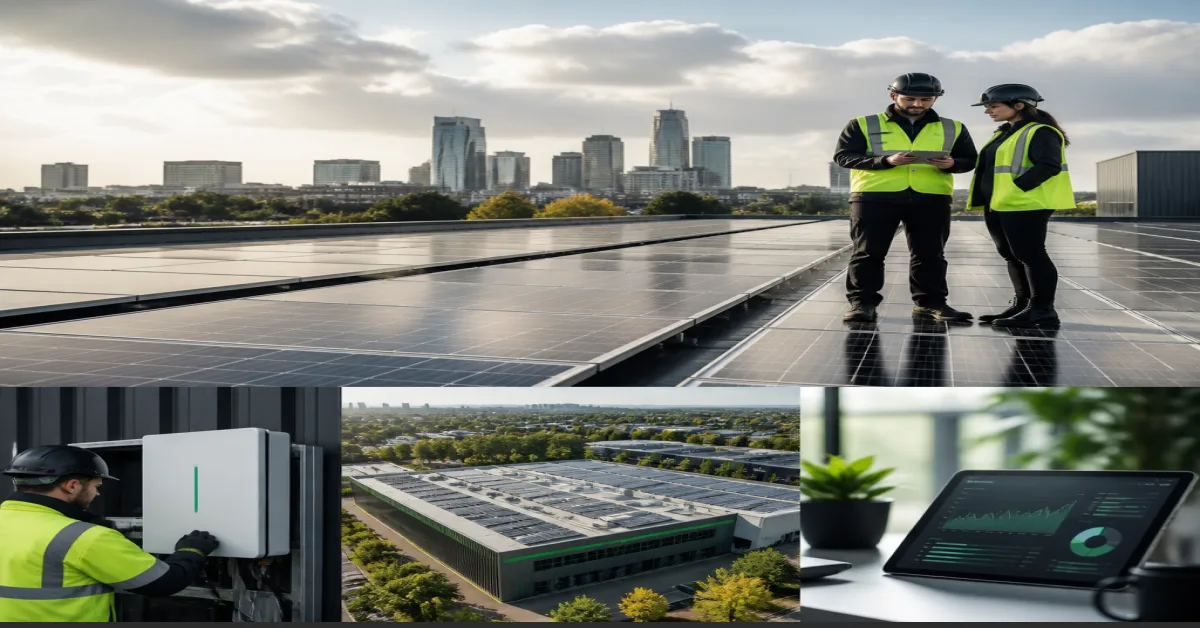
Commercial Solar Case Studies | Bee Solar UK Projects
Explore our commercial solar case studies across the UK. See how we help warehouses, factories, and offices reduce energy costs and carbon footprints.
Real UK Results Bee Solar Delivers for Commercial Sites
200+
Commercial projects delivered
Across England, Wales and Scotland with UK tariffs and G99 compliance.
4.8/5
Average client rating • 98% on time
Completion record on live, occupied commercial sites.
30,000+
tCO2 offset annually
Through installed commercial systems now in operation.
Bee Solar has delivered more than 200 commercial solar projects across the UK, with 98% completed on time and an average client rating of 4.8 out of 5. The company also offsets more than 30,000 tCO2 annually through the systems it has installed. A valid commercial case study from Bee Solar contains four elements only: the sector, the system size in kWp, the financial outcome in pounds or percentage of consumption, and the carbon or grid-dependency result.
As a Manchester-based installer serving UK businesses, Bee Solar uses this page to show what real installations achieve on UK sites with UK electricity costs, not US dollar figures. Many case-study pages ranking for this search term feature American projects and $ savings that do not translate to UK tariffs, G99 grid connection rules, or MCS/EPC context. This hub is built from UK sites, UK pounds, and survey-dependent outcomes. You can learn more about the company behind these projects and our track record of 200+ installations on our About Us page.
The results below are project-specific. Bee Solar does not promise the same outcome for every client; an exact return depends on a free site survey of your roof, load profile, and grid connection. Contact 0161 570 0596 to discuss your site. To see the full range of completed installations across different sectors, you can browse our full case study library.
Commercial Solar Results by Sector at a Glance
This table compares the four main commercial sectors Bee Solar works in, so you can match your building type to a realistic scale of result before reading the detailed case studies. It puts system size, financial outcome, and carbon result in one view—something many competitor pages scatter across separate project cards.
| Sector | Example System Size | Financial / Consumption Outcome | Carbon / Grid Outcome | Additional Kit (Where Used) |
|---|---|---|---|---|
| Warehouse & Logistics | 500kWp Manchester / 350kWp Leeds | Over £80,000 saved annually per site | Carbon footprint cut by more than 40% | None specified |
| Manufacturing & Industrial | 750kWp Birmingham | System covers 55% of annual electricity consumption | Reduced grid electricity demand | 200kWh battery storage |
| Office & Retail | 150kWp Liverpool | Strong ROI through smart design (specific £ not provided) | Reduced grid dependency | Integrated EV charging points |
| Agricultural & Rural | 200kWp Cheshire (ground-mounted) | Reduced grid dependency (specific £ not provided) | Lower grid reliance for farm operations | Ground-mounted array for grain drying and milk chilling |
Warehouses typically see the highest returns because of large, unshaded roofs and high daytime electricity demand that aligns with solar generation hours. This is a typical pattern across the sector, not a guarantee for every warehouse site.
Warehouse and Logistics Solar Case Studies
Warehouse clients typically see the highest returns on commercial solar due to large, unshaded roof areas and high daytime electricity demand that matches solar generation hours. Distribution centres and cold storage facilities are strong candidates when the roof condition and load profile are confirmed by a survey. The combination of expansive roof space and operations running during daylight hours is why logistics sites tend to outperform smaller commercial buildings on return. For a deeper dive into the specifics of this sector, see the solar business case for warehouses.
Manchester
500kWp
Distribution centre rooftop system, saving over £80,000 annually.
Leeds
350kWp
Cold storage rooftop system, saving over £80,000 annually.
Carbon Result
-40%+
Both sites cut their carbon footprint by more than 40%.
- ✓Manchester distribution centre: 500kWp rooftop system, saving over £80,000 annually.
- ✓Leeds cold storage facility: 350kWp rooftop system, saving over £80,000 annually.
- ✓Both sites cut their carbon footprint by more than 40%.
These projects operate on live, working logistics sites. The results shown are real outcomes for those specific sites; the roof area, orientation, and daily energy load of your warehouse determine what is achievable. Large logistics roofs combined with daytime operations create the conditions for stronger typical returns than smaller office roofs, which is why the warehouse sector leads Bee Solar's case study results.
Manufacturing and Industrial Solar Case Studies
Manufacturing sites require careful load profiling to match solar generation with machine demand. A factory running heavy equipment during daylight hours needs a system sized to its specific consumption pattern, not a generic rooftop array. Without this analysis, a system can be undersized for peak demand or oversized for the site's actual base load. To understand more about the load-profiling approach for these environments, explore industrial solar for factories.
750kWp
Birmingham automotive parts manufacturer
Rooftop system sized to machine demand
200kWh
Battery storage unit
Stores excess for peak demand periods
55%
Annual electricity covered
Of site consumption met on-site
- ✓Birmingham automotive parts manufacturer: 750kWp rooftop system.
- ✓Combined with a 200kWh battery storage unit to store excess generation for peak demand periods.
- ✓The system covers 55% of the site's annual electricity consumption.
Battery storage was added on this project because load profiling showed a clear match between solar generation and the factory's peak machine demand. The storage was specified to capture surplus generation during lower-demand periods and release it when machinery load spiked. Storage is a site-led decision, not a default upsell for every manufacturing client. The 55% consumption figure reflects the specific balance of rooftop generation, battery capacity, and the plant's operating hours.
Office and Retail Solar Case Studies
Office buildings and retail parks often have smaller roof areas than warehouses, but they can still achieve strong ROI through smart system design. The key is to match the system size to the building's daytime base load and any additional electrical demand such as EV charging. A smaller roof constrains system size, but it does not eliminate the business case when other loads can be served directly. For a closer look at how these systems are tailored, review the specifics of solar viability for office buildings.
Liverpool Office Complex
150kWp Rooftop
Integrated EV charging points power both the building and a fleet of company electric vehicles.
Design Insight
Small roof + EV fleet = strong case
Financial savings and carbon figures for this project are not published, but the system reduces reliance on grid electricity.
- ✓Liverpool office complex: 150kWp rooftop system.
- ✓Integrated EV charging points power both the building and a fleet of company electric vehicles.
- ✓Financial savings and carbon figures for this project are not published, but the system reduces reliance on grid electricity.
A smaller roof does not mean solar is not viable. In this case, the presence of a company EV fleet created an additional daytime electrical load that could be served directly by on-site generation, improving the overall business case without needing a large roof area. EV load can be part of the system design when the site has vehicles that charge during working hours, turning a transport electrification requirement into part of the solar business case.
Agricultural and Rural Solar Case Studies
Farms and rural businesses benefit from both roof-mounted and ground-mounted solar arrays, depending on the available space and the electrical equipment that needs power. Agricultural operations often have high loads for processing equipment that runs at specific times of day, such as grain drying after harvest or milk chilling throughout the day. For a broader view of what is possible on a farm, it is worth reviewing the agricultural solar options available.
200kWp Ground-Mounted
Cheshire dairy farm: 200kWp ground-mounted system.
Reduced Grid Dependency
Reduced grid dependency for the farm's operations.
Process Powered
Provides power for new grain drying and milk chilling equipment.
Ground-mounted arrays are a rural option when roof area is limited or when the electrical load is better served by a dedicated ground array. This project used ground-mount because the dairy operation had specific drying and chilling loads that needed a reliable, on-site power source. Ground-mount is not a default for urban warehouses; it is the practical solution for farms with land and a high daytime processing load.
Free Site Survey, Proposal, and 24-Hour Response
Every commercial solar project at Bee Solar starts with the same three-step process: a free site survey, a detailed proposal, and a clear no-obligation decision point. This process is how Bee Solar ensures the numbers for your site are accurate before any commitment. The 24-hour response SLA and survey-first approach are differentiators that most US-focused case-study hubs do not offer.
Contact Bee Solar
Contact Bee Solar on 0161 570 0596 or enquire through the website.
24-Hour Response & Survey
Receive a response within 24 hours to arrange a free site survey. Engineers visit the property to assess roof condition, orientation, electrical load, and grid connection.
Detailed Proposal
Receive a detailed proposal with project-specific costs, savings, and carbon impact. There is no obligation to proceed with the survey or after receiving the proposal.
- Contact Bee Solar on 0161 570 0596 or enquire through the website.
- Receive a response within 24 hours to arrange a free site survey. Engineers visit the property to assess roof condition, orientation, electrical load, and grid connection.
- Receive a detailed proposal with project-specific costs, savings, and carbon impact. There is no obligation to proceed with the survey or after receiving the proposal.
Bee Solar does not promise transferable ROI for any site until that survey is complete. Before you get in touch, you can use our tools to estimate your own payback as a preliminary step. The 24-hour response and the free, no-obligation survey are the concrete first steps that move a project from consideration to a defined proposal. Call 0161 570 0596 to start the process, or request a free site survey online.
Frequently Asked Questions
What results have Bee Solar warehouse and logistics projects achieved in the UK?
Bee Solar completed a 500kWp system on a Manchester distribution centre and a 350kWp system on a Leeds cold storage facility. Both sites are saving over £80,000 annually and cut their carbon footprint by more than 40%. These are the actual outcomes for those two sites, not a typical range for all logistics projects.
Are commercial solar savings and carbon figures guaranteed for every site?
No. The figures published on this page are the real outcomes for the specific projects listed. Savings, carbon reduction, and system performance depend on the roof condition, site location, electricity consumption profile, and grid connection. Bee Solar provides an accurate projection only after a free site survey.
What happens after I enquire about a commercial solar installation?
After you contact Bee Solar on 0161 570 0596, you receive a response within 24 hours to arrange a free site survey. An engineer visits the property and delivers a detailed proposal with project-specific costs, savings, and carbon impact. There is no obligation to proceed.
Get Your Free Commercial Site Survey
Join 200+ UK businesses cutting costs and carbon with Bee Solar. Response within 24 hours — no obligation.