
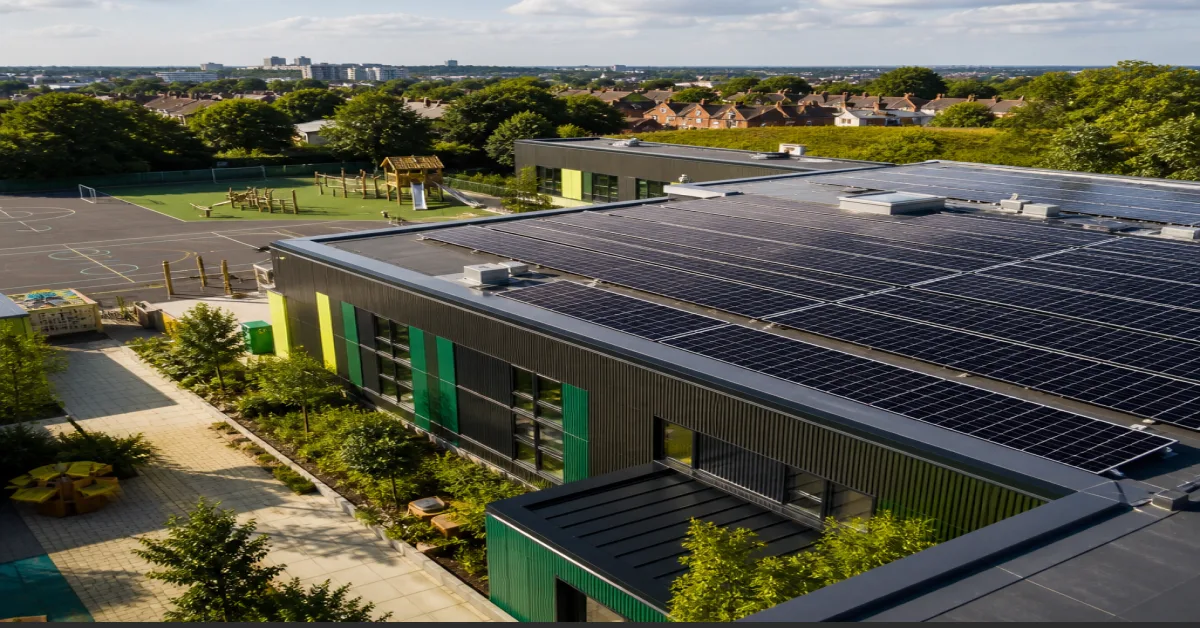
Primary School Solar Installation | 120 kWp Leeds Case Study
See how Bee Solar reduced Park Lane Primary Academy's energy bills by 63% with a 120 kWp solar installation. Non-penetrating mounts and STEM integration.
Client
Park Lane Primary Academy
Location
Leeds, West Yorkshire
System Size
120 kWp
Completed
2024
Park Lane Primary Academy: 120 kWp Proof for UK Educational Estates
Park Lane Primary Academy in Leeds, West Yorkshire, is a 420-pupil primary school with a 120 kWp rooftop solar array, completed in 2024. This UK academy project was evaluated on bills, payback, and operations, not US tax-credit or PPA programmes. Bee Solar, the Manchester-based commercial installer, delivered the system, which is designed to offset 62% of the school's daytime electricity demand.
This project is proof of concept for governors, headteachers, and academy trust bursars considering how a commercial-scale array performs on a real educational estate. The installation also functions as an interactive STEM teaching resource through live generation dashboards in every classroom. For readers arriving from US-focused school-solar search results, the Leeds and West Yorkshire context confirms this is a UK academy estate project with UK financial logic.
- Client: Park Lane Primary Academy
- Location: Leeds, West Yorkshire
- System size: 120 kWp
- Completed: 2024
- Daytime offset: 62% (not 100% independence)
Rising Energy Costs Versus Teaching Budgets
Annual energy costs exceeding £45,000 were consuming capital that could otherwise support teaching staff at Park Lane Primary Academy. For a primary school, that sum represents a material budget line that competes directly with educational resources, making the financial case for rooftop solar a matter of estate-budget defence rather than a CSR slogan. The decision to pursue a rooftop array was driven by this direct cost pressure on the school's operational budget.
Decision for trustees
A quantified bill reduction and payback period are required to justify the capital outlay; the outcomes at Park Lane provide that evidence. Without a measurable return, diverting funds from teaching resources to energy infrastructure is difficult to defend to an academy trust board. For context on how this project fits within the wider landscape, you can explore solar for UK school estates.
- Annual energy cost: £45,000+ competing with teaching budgets
- Evidence-led case: quantified bill reduction and payback required
Waterproofing a Recently Repaired Flat Membrane Roof
Bee Solar began with a full structural and waterproofing assessment before designing a non-penetrating ballasted mounting system, which holds the array in place without roof penetrations. Tier 1 all-black panels were selected for aesthetic discretion on the school elevation.
Decision: a non-penetrating ballasted system is the correct choice for a recently repaired flat membrane after a structural survey has confirmed load capacity. This approach preserves the warranty position on the new membrane and eliminates the most common cause of post-installation leaks.
Structural assessment
Full structural and waterproofing assessment confirmed the roof could carry the additional load before any design work proceeded.
Ballasted mounting
Non-penetrating ballast blocks distribute the load across the membrane surface rather than concentrating it at fixing points.
Tier 1 panels
Tier 1 all-black panels were selected for aesthetic discretion on the school elevation with no breach to waterproofing.
Penetrating a newly repaired membrane is the mistake this design avoids; using ballasted mounting removes the leak risk entirely.
Zero-Disruption Installation in the Summer Holiday Window
The installation was completed over three weeks in July with zero operational impact and zero disruption to school operations. The holiday slot is a programme constraint, not a marketing footnote: the survey and design phases must be scheduled early enough to secure the summer window.
Early survey
Survey and structural assessment scheduled early in the year.
Holiday slot
Summer holiday slot reserved for the three-week installation programme.
Safe access
Contractor access managed so pupils are never on site during works.
Commissioning
Commissioning and dashboard setup completed before staff return in September.
Quantified Outcomes: Bills, Payback, Offset, and Export
The annual electricity bill at Park Lane Primary Academy was reduced by £28,400, a 63% reduction, with a projected payback period of 5.4 years. The 120 kWp array offsets 62% of daytime electricity demand; it does not make the school 100% energy independent. To model a similar financial case for your own estate, you can estimate your own payback.
Annual bill reduction: £28,400 (63%)
Projected payback: 5.4 years
Daytime offset: 62% (not 100%)
Carbon reduction: 36 tonnes CO2e per year
SEG export income: £4,800 annually from holiday generation
| Metric | Result |
|---|---|
| Annual bill reduction | £28,400 (63%) |
| Projected payback | 5.4 years |
| Daytime offset | 62% (not 100%) |
| Carbon reduction | 36 tonnes CO2e per year |
| SEG export income | £4,800 annually from holiday generation |
The 62% daytime offset is paired with SEG income from generation during holidays, so the system still delivers value when the school is empty. For a deeper understanding of this revenue stream, you can read about how SEG export payments work.
STEM Teaching Resource: Live Dashboards and Key-Stage Packs
Live generation dashboards in every classroom display real-time electricity generation, carbon savings, and weather correlation data. STEM teaching packs were delivered to all key stage groups. These learning tools are supported by the system's ongoing maintenance and monitoring.
Live dashboards
Teachers can use the live data for maths exercises on units and conversion, science lessons on energy transfer and weather effects, and geography work on seasonal generation patterns.
Key-stage packs
The key-stage packs provide structured activities that align with curriculum requirements, giving governors a concrete educational return from the capital investment.
Appointing a Regional Installer and Starting with a Free Site Survey
Bee Solar, based in Manchester, delivered this Leeds primary school installation in 2024 and provides commercial solar installation across the region. Every project starts with a free site survey. For a detailed look at what this initial phase entails, you can review our energy audit process.
250 kWp warehouse
250 kWp warehouse solar array, Mersey Logistics Ltd, Liverpool.
120 kWp carport
120 kWp carport canopy solar, Yorkshire Retail Park, Leeds – another Leeds-based rooftop project.
150 kWp hotel
150 kWp boutique hotel solar, Cotswold Country House Hotel, Cheltenham – a 150 kWp hotel installation.
Project cost depends on the survey; there is no fixed price per school without a structural assessment. The payback and bill outcomes at Park Lane Primary Academy are the evidence proxy for what a similar estate can expect.
Want results like this? Start your project with a free site survey. Call Bee Solar on 0161 570 0596.
Frequently Asked Questions
Are solar panels worth it for UK primary schools?
For Park Lane Primary Academy, the £28,400 annual bill reduction (63%) and 5.4-year projected payback demonstrate clear financial value. The system also delivers a 36-tonne CO2e annual carbon reduction and £4,800 SEG export income from holiday generation, making the business case robust for similar institutional estates with flat roofs and daytime demand profiles.
How much does it cost to put solar panels on a school?
Cost depends on the structural survey, roof condition, and system size. No accurate figure can be given without a site survey; the outcomes at Park Lane, including the payback period and bill reduction, are the best cost-effectiveness evidence available pre-survey. A free site survey from Bee Solar provides a project-specific cost estimate based on measured roof and structural data.
Will a rooftop array make a school 100% energy independent?
No. The Park Lane array offsets 62% of daytime electricity demand. Schools still draw from the grid when generation is lower than consumption, particularly outside daylight hours and during winter months; independence claims are not supported by this project. Holiday generation is exported under SEG, which provides income but does not contribute to on-site offset.
How do you install solar on a recently repaired flat membrane without leaks?
By using a non-penetrating ballasted mounting system, which holds the array in place by weight after a full structural and waterproofing assessment. No fixings breach the membrane, so waterproofing integrity is preserved. The ballast distribution is calculated to respect the structural load capacity of the roof deck.
Can installation be completed without disrupting term time?
Yes. The Park Lane installation was completed over three weeks in July with zero operational impact and zero disruption to pupils. The key is to schedule the survey and design early enough to secure the summer holiday slot; late survey scheduling risks missing the window and delaying the project by a full academic year.
Do you size school systems using a 33% rule?
No. System sizing at Bee Solar is based on measured daytime electricity demand, roof area, structural load capacity, and the waterproofing survey, not a fixed percentage rule. Fixed percentage rules do not account for the specific consumption profile of an individual school estate.
Is planning permission always required for school rooftop solar in England?
Not always. Some rooftop installations may fall under permitted development, but whether a specific school roof qualifies depends on its location, design, and local authority requirements. A site survey should confirm planning status before procurement. Planning is not a barrier at Park Lane, but each school must be assessed on its own circumstances.
What educational benefit do governors actually get beyond bill savings?
At Park Lane, live generation dashboards in every classroom display real-time data on electricity generation, carbon savings, and weather correlation. STEM teaching packs covering all key stages were delivered as part of the project, making the array an operational curriculum resource. These tools provide measurable educational value that can be cited in governor reports on the capital project's wider benefits.
Want Results Like This?
Every project starts with a free site survey. Let us show you what solar can do for your building.