
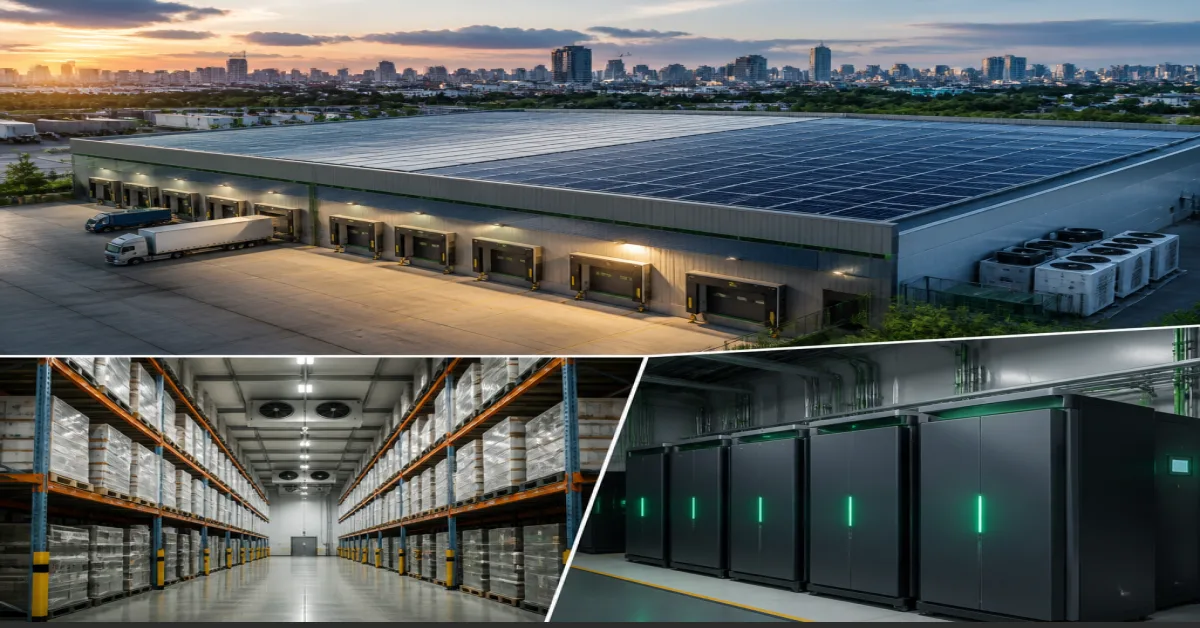
Cold Storage Solar Manchester | 350 kWp Case Study | Bee Solar
See how Bee Solar reduced refrigeration energy costs by 46% for a Manchester cold storage facility using a 350 kWp solar and 300 kWh battery system.
Client
Manchester Cold Chain Ltd
Location
Manchester, Greater Manchester
System Size
350 kWp / 300 kWh BESS
Completed
2024
Manchester Cold Chain Ltd: Grid-Tied PV + BESS, Not a Walk-In Solar Cold Room
Bee Solar completed a 350 kWp solar PV and 300 kWh battery energy storage system (BESS) project in 2024 for Manchester Cold Chain Ltd at a 45,000 sq ft frozen food distribution centre in Manchester, Greater Manchester. This is a grid-tied commercial solar installation with lithium iron phosphate (LFP) storage and an energy management system (EMS), designed to offset refrigeration electricity, protect the cold chain during outages, and improve BRC audit sustainability evidence. It is not an off-grid container room, a domestic 5–15 kWh home battery, or refrigeration plant supply or hire. For a broader look at how this technology applies across the sector, see our dedicated page on solar for cold storage facilities.
- This project is: A 350 kWp / 300 kWh commercial PV+BESS system on a UK frozen food DC.
- This project is not: A productised solar cold room, a residential battery, or an off-grid farm installation.
- Provider: Bee Solar, local commercial installer. Next step: free site survey or 0161 570 0596.
The Challenge: 24/7 Refrigeration Cost, Crowded Roof, and Temperature Risk
The 45,000 sq ft facility consumed over £180,000 in electricity annually, with refrigeration compressors accounting for 68% of total demand. The primary design friction was a roof crowded with HVAC condensers and evaporator units, not a generic “busy roof.” The operations director’s core concern was temperature stability and cold chain integrity during any grid disruption — a failed compressor or an extended outage could mean product loss, missed retailer delivery windows, and an audit finding.
The roofing constraint mattered more than generation capacity. A conventional flat-roof solar layout would have been forced to avoid every condenser and evaporator, losing large sections of usable area. Bee Solar’s engineering approach had to treat the plant equipment as fixed operational assets, not obstacles to remove.
Key Constraints
- Annual electricity cost: £180,000+
- Refrigeration compressor share: 68% of total demand
- Design friction: HVAC condensers and evaporator units on the roof
- Operational risk: Temperature stability during grid disruption
Solution Design: Drone Roof Survey, CAD Layout, and 350 kWp / 300 kWh BESS
Bee Solar used a drone roof survey and CAD layout that recovered 65% usable area by elevating panels above existing plant equipment. The installed system pairs a 350 kWp array with a 300 kWh lithium iron phosphate (LFP) battery, managed by an EMS that prioritises refrigeration loads, schedules non-critical defrost cycles during peak solar hours, and provides 60 minutes of critical load backup.
System specification: 350 kWp solar PV array, 300 kWh LFP battery, EMS with refrigeration load priority, 60 minutes critical load backup. This is a commercial-class storage system, not a residential battery: 300 kWh is the scale required for a 24/7 compressor load, not the 5–15 kWh typical of home systems.
Drone survey
High-resolution aerial mapping identified every HVAC condenser, evaporator unit, and roof obstruction before any design work began.
CAD layout
Precise positioning of the elevated array ensured maximum solar exposure while keeping full service access to all plant equipment below.
Elevated mounting
Panels raised above condenser heights recovered 65% of the roof area that a standard ground-level array layout would have sacrificed.
EMS logic
Compressors remain the priority load; defrost cycles are shifted into solar generation hours to maximise self-consumption.
Gallery captions should show the elevated array working around HVAC condensers and evaporators, not generic roof shots. This design was delivered for this specific Greater Manchester frozen DC, not a hypothetical UK warehouse.
Why Solar Plus Battery, Not Solar-Only, on a Cold Store
Pairing the 350 kWp array with the 300 kWh BESS raised refrigeration load offset to 65% and enabled 60 minutes of critical-load backup; solar-only would not deliver this load priority or outage hold. The EMS prioritises compressors first and moves defrost cycles into solar hours. Honest limit: the remaining refrigeration still runs on grid power, and 60 minutes is not unlimited backup.
| Capability | Solar-Only | Solar PV + 300 kWh BESS |
|---|---|---|
| Refrigeration load offset | Partial, generation-dependent | 65% with battery dispatch |
| Grid outage hold | None | 60 minutes critical load |
| Load priority | No control | Compressors first, defrost in solar hours |
| Grid reliance | Full when not generating | Partial; remaining load on grid |
The battery is justified by the load profile: a 24/7 compressor demand that aligns poorly with solar generation. Without storage, the site would export generation and import at night. With a 300 kWh BESS, the site shifts solar into evening peaks and holds critical loads through short outages. This principle of using a battery for critical load backup is demonstrated in our data centre solar and battery case study, which shares a similar design philosophy for essential infrastructure.
A solar-only system on this site would have captured daytime generation but left the site fully exposed to evening peak pricing and every grid disturbance. The 300 kWh battery is what turns the array from a generation asset into a refrigeration resilience tool.
Project Results: £84,000 Bill Cut, 65% Refrigeration Offset, BRC C to A
Annual electricity bill reduced by £84,000 (46%); refrigeration load offset increased to 65% with battery; cold chain protected during 3 grid outage events in the first year; carbon footprint reduced by 110 tonnes CO2e annually; BRC audit sustainability score improved from C to A. These results are for Manchester Cold Chain Ltd, completed 2024, Manchester, Greater Manchester. The value of proactive system care is highlighted in a case study on performance recovery for cold storage PV.
Annual electricity bill reduction: £84,000 (46%)
Refrigeration load offset: 65% with battery
Grid outage protection: 3 events, cold chain maintained
Annual carbon reduction: 110 tonnes CO2e
BRC audit sustainability score: C to A
| Metric | Result |
|---|---|
| Annual electricity bill reduction | £84,000 (46%) |
| Refrigeration load offset | 65% with battery |
| Grid outage protection (year one) | 3 events, cold chain maintained |
| Annual carbon reduction | 110 tonnes CO2e |
| BRC audit sustainability score | C to A |
The 65% refrigeration offset was achieved by the compressor-first EMS, which prioritises the largest electrical load on site. The BRC improvement from C to A gives retailer-facing operations managers auditable sustainability evidence, not a generic environmental claim. For a frozen food DC supplying major UK retailers, a BRC sustainability score of A translates into a commercial advantage during supplier reviews and tender renewals.
Who This Manchester Cold Storage Solar Project Is For
This project is for Operations Directors and Facility Managers of UK cold-chain and frozen food distribution centres with high compressor loads, crowded roofs, and BRC or retailer audit pressure. It is also for commercial sites in Manchester and Greater Manchester that need a local installer who understands refrigeration-critical load profiles and plant-heavy roofs. For a comparison with a similar 24/7 operation, you can review our work on solar for 24-hour distribution warehouses.
Good fit
- UK frozen food or cold-chain DC with refrigeration as the dominant load.
- Roof with HVAC condensers, evaporators, or other plant obstructions.
- Need to improve BRC or retailer sustainability scores.
- Wanting outage protection for critical refrigeration, not full site backup.
- Manchester / Greater Manchester commercial site (or similar UK DC).
- Facilities spending over £150,000 annually on electricity where refrigeration dominates the bill.
Not a fit
- Seeking 100% energy independence or off-grid operation.
- Looking for a domestic 5–15 kWh home battery.
- Buying a walk-in cold room or refrigeration hardware.
- Expecting a refrigeration contractor to design a PV+BESS system.
- Needing only a solar array with no interest in outage protection or load prioritisation.
From Free Manchester Site Survey to Install, EMS, and Aftercare
Every project starts with a free site survey. The Manchester job followed this process: survey, drone roof survey and CAD design, installation, EMS commissioning, and ongoing monitoring. Bee Solar provides solar PV and battery storage for commercial sites in Manchester and Greater Manchester. Contact 0161 570 0596 to start.
Free site survey
Assess the roof, electrical infrastructure, and refrigeration load profile. This includes reviewing your half-hourly electricity data to confirm the compressor share and overnight demand pattern.
Drone roof survey and CAD layout
Map HVAC plant and design an elevated array to recover usable area that a standard layout would lose to plant setbacks.
Installation
Install the PV array and battery, working around existing plant and scheduling work to avoid disrupting live refrigeration operations.
EMS commissioning
Configure load priority so refrigeration always wins; schedule defrost into solar hours; test the 60-minute critical load hold.
Monitoring and aftercare
Track performance and maintain the system, with related services for ongoing monitoring services. System alerts flag any drop in generation or battery performance before it affects refrigeration offset. For long-term performance, explore our solar maintenance plans.
Risk reduction is built into the process: work happens around HVAC plant, refrigeration is the priority load, and the system does not overpromise independence. Other projects demonstrate this local capability, such as the 500 kWp Stockport manufacturing project which also pairs PV with battery storage. To begin, simply use the Start Your Project enquiry form.
Want results like this? Start your project with a free site survey. Call 0161 570 0596.
Frequently Asked Questions
Can a Manchester cold storage facility run on solar energy?
Yes, a Manchester cold storage facility can run partially on solar energy. This project at Manchester Cold Chain Ltd offsets 65% of refrigeration electricity with a 350 kWp array and 300 kWh battery. The site remains grid-tied, and the remaining 35% of refrigeration load plus other facility demand still draws from the grid. A facility that wants a higher offset would need a larger battery or additional generation, but for most DCs the economics favour a partial offset with battery dispatch rather than chasing full independence.
What are the drawbacks of solar for refrigeration and how did BESS address them on this project?
The main drawbacks are intermittency, roof obstructions, and the mismatch between solar generation and 24/7 compressor demand. On this project, the BESS stores solar generation for evening peaks and provides 60 minutes of critical load backup during outages. The EMS also shifts defrost cycles into solar hours to improve self-consumption. The system does not achieve 100% independence. A further drawback is that a plant-heavy roof reduces usable area; the drone survey and elevated array recovered 65% of what would otherwise have been lost to HVAC setbacks.
Why is 350 kWp / 300 kWh the right scale versus a domestic solar battery?
A 300 kWh commercial LFP battery is the scale needed for a 45,000 sq ft frozen food DC where refrigeration compressors account for 68% of demand. Domestic batteries are typically 5–15 kWh and cannot hold a commercial compressor load. The 350 kWp array matches the site’s daytime generation needs, and the 300 kWh battery provides meaningful load shifting and outage cover. A residential system would cover only a fraction of one compressor’s running demand and would offer negligible outage protection for a frozen food DC.
Does cold storage solar mean 100% energy independence?
No. This is a grid-tied system, and even with 65% refrigeration offset and 60 minutes of critical backup, the site still relies on the grid for the remaining load. No commercial cold store of this size should expect full off-grid operation from a PV+BESS system unless it is specifically designed for that, which this was not. Full independence would require a generator or a much larger battery bank, neither of which is commercially sensible for a grid-connected DC in Greater Manchester.
How did drone roof surveys and CAD layouts deal with HVAC condensers on a crowded roof?
Drone surveys mapped the exact positions of HVAC condensers and evaporator units. CAD layouts then elevated the PV array above this plant equipment, recovering 65% usable roof area. This avoids removing or relocating operational HVAC units and allows the array to generate without shading from plant. The elevated mounting also preserves maintenance access: technicians can still reach condensers and evaporators for servicing without dismantling solar infrastructure.
How did this project affect BRC audit sustainability scoring?
The BRC audit sustainability score improved from C to A. The 110 tonnes CO2e annual reduction and the measurable 46% electricity bill cut provided auditable evidence of sustainability improvement, which is directly reportable in retailer-facing compliance documentation. The improvement moved the site from a compliance-flagged rating to a top-tier sustainability score, which strengthens its position in retailer supplier reviews.
What happened to refrigeration during grid outages in the first year?
Refrigeration was protected during 3 grid outage events in the first year. The 300 kWh battery and EMS held critical refrigeration loads for 60 minutes per event, maintaining the cold chain and preventing temperature drift during those disruptions. The EMS automatically detected the grid loss and isolated critical loads onto battery power without manual intervention. All three events passed without product temperature deviation.
Is this the same as buying a solar-powered walk-in cold room?
No. This is a grid-tied commercial PV+BESS installation on a 45,000 sq ft distribution centre, not a productised walk-in cold room. Walk-in cold rooms are standalone refrigeration units, often with small solar PV. This project is a large-scale grid-tied system designed to offset most refrigeration electricity and provide short outage cover. A walk-in cold room unit typically serves a single chilled space; this system serves an entire frozen food DC with multiple freezer zones and a compressor bank.
How do I start a cold storage solar survey with Bee Solar in Manchester?
Start by requesting a free site survey. Call 0161 570 0596 or use the Start Your Project enquiry form. The survey covers your roof, electrical infrastructure, and refrigeration load profile, leading to a drone survey and CAD design for your specific Manchester site. The survey typically takes one visit, and you will receive a design proposal with projected offset and payback before any commitment to install.
Want Results Like This?
Every project starts with a free site survey. Let us show you what solar can do for your building.